Growing cucumbers vertically is one of the most rewarding decisions a vegetable gardener can make. It solves problems, creates opportunities, and transforms the productivity of a garden space in ways that ground-level cucumber growing simply cannot match.
The problems it solves are significant. Cucumbers grown on the ground take up enormous horizontal space, develop fruit that bends and curves against the soil surface, suffer from powdery mildew and rot where leaves and fruit sit in contact with damp earth, and become difficult to harvest because the fruit hides beneath dense foliage. A cucumber trellis eliminates every one of these problems simultaneously. The vines grow upward rather than outward, the fruit hangs straight and clean in the open air, the foliage stays dry and disease-resistant, and every cucumber is clearly visible and easily accessible at harvest time.
The opportunities a cucumber trellis creates are equally significant. A vertical growing system turns a single linear garden bed into a productive wall of cucumber vines that provides shade for heat-sensitive plants beneath, creates a dramatic visual feature in the productive garden, and can produce two to three times more fruit from the same ground footprint as a sprawling horizontal planting.
And the options for how to build, buy, or create a cucumber trellis are almost as numerous as the reasons to use one. These 15 cucumber trellis ideas cover every material, every budget, every garden size, and every level of DIY confidence from the complete beginner to the experienced kitchen gardener. Whether you have a raised bed, an in-ground plot, a cottage garden, or a small urban growing space, there is a cucumber trellis idea here that will work for your garden and your cucumbers.
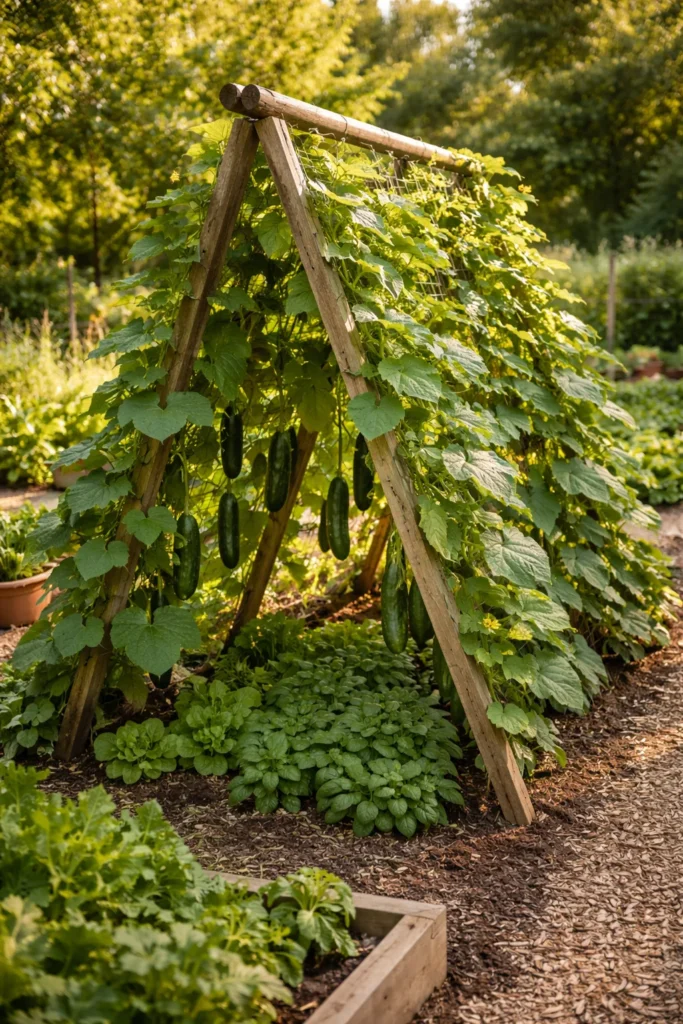
1. Classic A-Frame Cucumber Trellis
The A-frame trellis is the most enduringly practical cucumber support structure in the vegetable garden because it solves the cucumber’s growing requirements so completely and so elegantly. Two panels meeting at a central ridge allow the vines to climb both sides simultaneously, the fruit hangs in the cool shaded interior between the frame legs where it develops straight and long, and the lower plants growing in the shaded ground beneath the frame benefit from the protection the structure provides. It is a complete productive system in a single simple form.
Tip: Plant a second cool-season crop in the shaded ground directly beneath the A-frame trellis. Lettuces, spinach, and herbs that bolt quickly in direct summer sun will thrive in the dappled shade beneath a mature cucumber A-frame, giving you productive use of garden space that would otherwise be too shaded to be useful. The A-frame creates a microclimate beneath it that extends the growing season for shade-tolerant plants well into summer.
2. Cattle Panel Arch Cucumber Tunnel
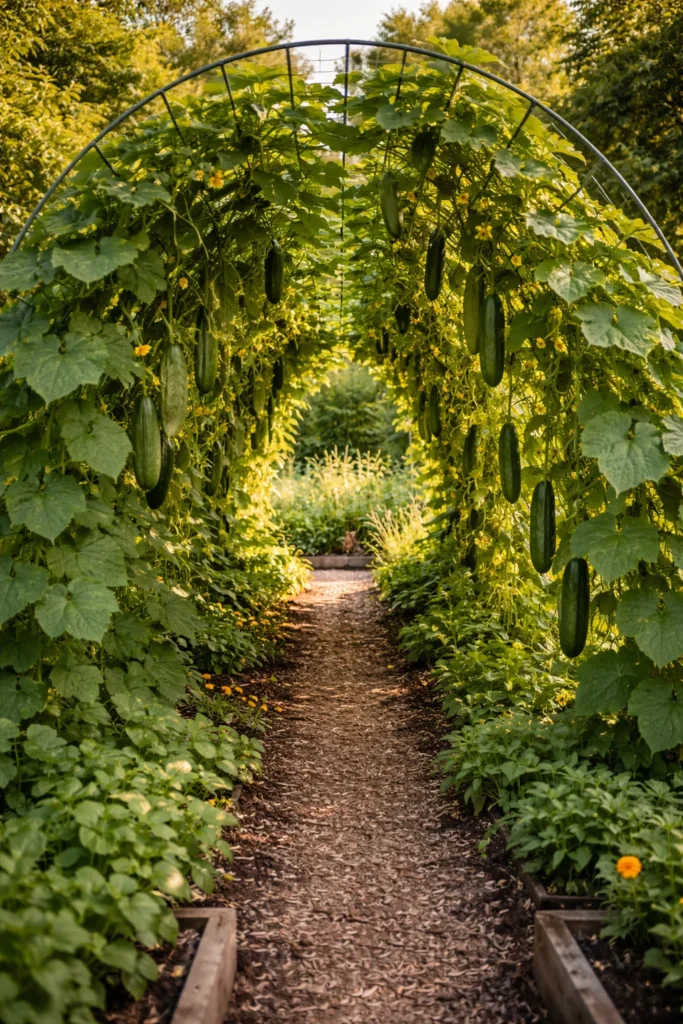
A sixteen foot cattle panel bent into an arch is the most dramatic and most visually spectacular cucumber trellis available for a vegetable garden, and it earns that drama completely through its productivity. The large arch surface accommodates an extraordinary volume of cucumber vine growth, the tunnel interior provides a walking and harvesting corridor, and the hanging cucumbers inside the arch develop the long straight form that makes them the most attractive and marketable cucumbers a home garden can produce. It is the trellis that makes people stop and ask questions.
Tip: Plant a different fast-growing climber such as climbing beans or sweet peas at the base of the cattle panel arch alongside the cucumbers in the first year of use. While the cucumbers take several weeks to establish and begin climbing, the companion climbers will colonize the lower sections of the arch immediately, reducing the bare metal panel visible in the early season and providing a productive harvest from the arch structure from the first weeks after installation.
3. DIY Bamboo Teepee Trellis
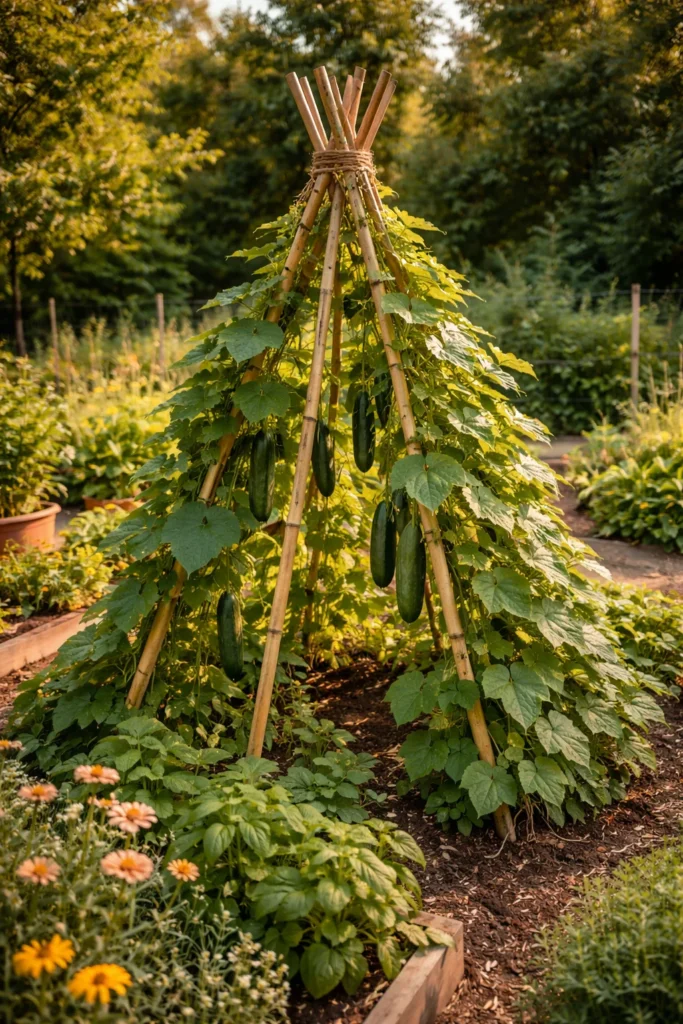
The bamboo teepee trellis is the kitchen garden structure that looks as if it grew there rather than being constructed, and that quality of natural belonging in the garden landscape is something that no metal or plastic trellis can replicate. The warm bamboo tones, the natural jute bindings, the irregular surface of each individual bamboo pole providing perfect grip for cucumber tendrils, and the tipi form’s inherent visual elegance make the bamboo teepee the trellis that gets photographed most often and admired most consistently in every garden it appears in.
Tip: Save the bamboo poles from your teepee trellis at the end of each growing season by removing the vines, washing the poles clean, and storing them in a dry location over winter. Quality bamboo poles used and stored correctly will last five to seven seasons, making the initial investment of sourcing or purchasing good bamboo poles genuinely worthwhile over a full period of garden use. Bamboo left outside over winter in contact with damp soil will degrade significantly faster than properly stored bamboo.
4. Wooden Ladder Trellis Cucumber
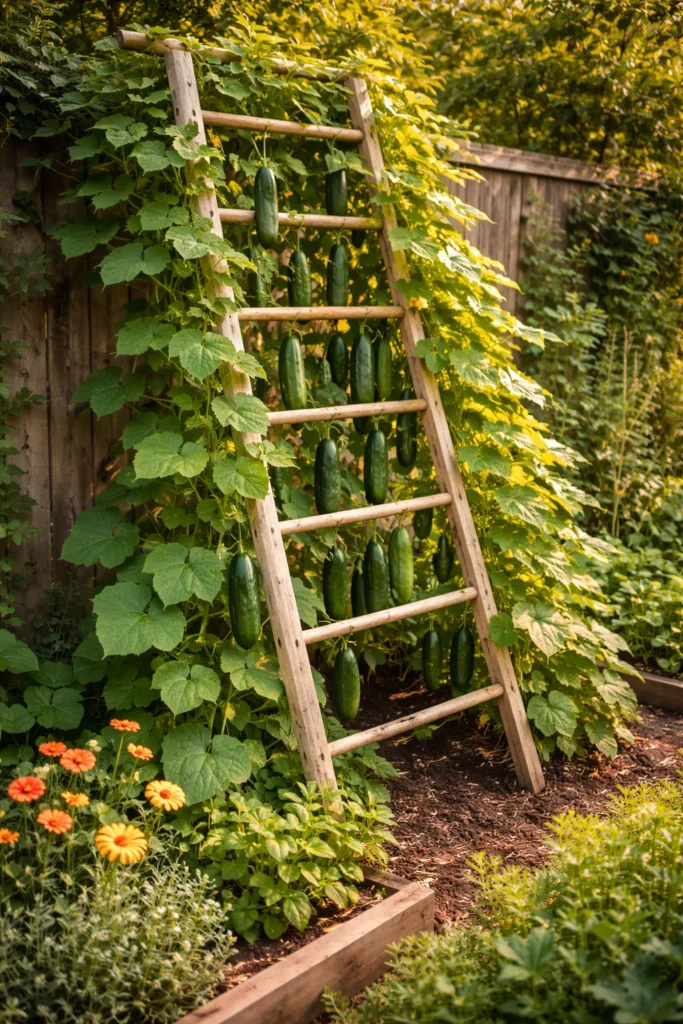
The wooden ladder trellis is the cucumber support structure for gardeners who appreciate the elegance of a simple and familiar form applied to a growing purpose. The ladder’s two rails and evenly spaced rungs are immediately intuitive for the vine, each rung providing a clear horizontal stepping stone in the upward growing journey, and the resulting growth habit is cleaner, more organized, and more easily managed than the more random growth that mesh or panel trellises can produce.
Tip: Paint or stain your wooden ladder trellis with a quality exterior wood preservative before the growing season begins and reapply at the end of each season before storage. Untreated wood in a garden environment, particularly where it is in regular contact with damp soil at the base and with watering at the vine level, will begin to show rot within two to three seasons. A properly treated wooden ladder trellis will remain structurally sound and visually attractive for ten or more growing seasons, making the annual maintenance investment genuinely worthwhile.
5. PVC Pipe Cucumber Trellis Frame
The PVC pipe frame trellis is the cucumber support solution for gardeners who prioritize practicality, affordability, and seasonal flexibility above aesthetics. The lightweight frame assembles and disassembles quickly without tools, the materials cost a fraction of metal or wood alternatives, the white pipe is weather-resistant and will not rot or rust, and the modular pipe-and-fitting system allows the frame dimensions to be adjusted to suit any garden bed size or cucumber variety. It is the trellis that works completely for gardeners who need a reliable solution rather than a beautiful one.
Tip: Store disassembled PVC pipe trellis components in labelled bundles at the end of each growing season so the frame can be reassembled quickly and without confusion at the start of the following year. The ease of reassembly is one of the PVC frame’s greatest practical advantages, and labelling the components, uprights, cross members, and corner fittings separately, means that a frame that took thirty minutes to construct in the first year can be reassembled in under ten minutes in every subsequent year.
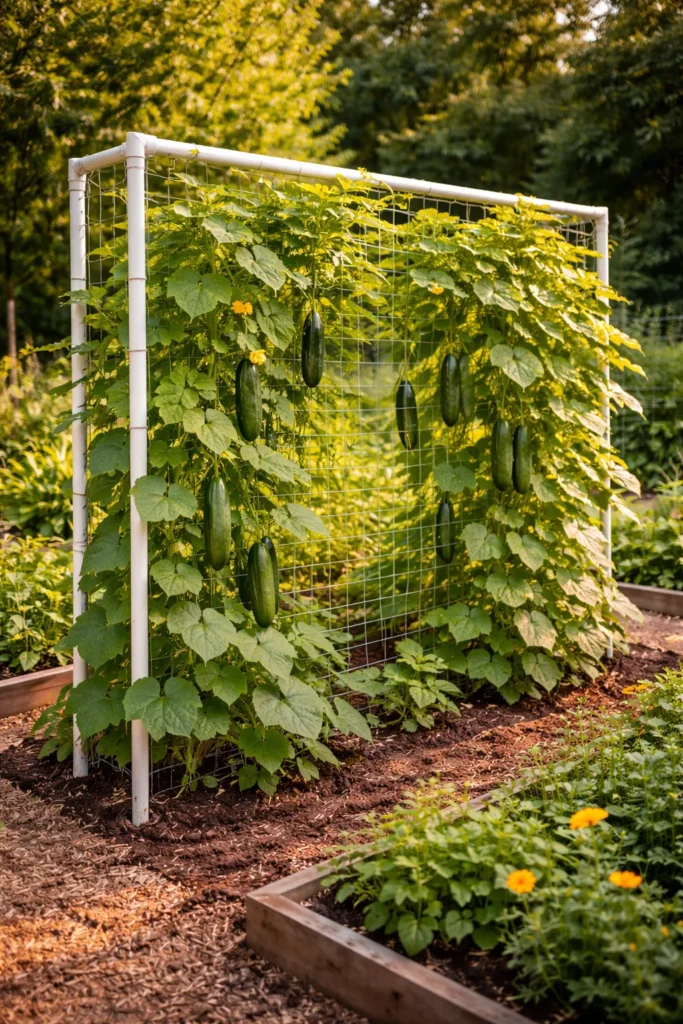
6. Wire Mesh Panel Trellis
The wire mesh panel trellis is the vegetable garden’s most straightforward and most reliably productive cucumber support structure. A rigid welded wire panel stretched between two solid posts does not flex, does not sag, does not require seasonal replacement, and provides a consistent climbing grid that cucumber tendrils grip naturally at every intersection. For gardeners who want a system that requires no annual maintenance, no seasonal replacement of materials, and no attention beyond the initial installation, the wire mesh panel is the correct choice.
Tip: Leave the wire mesh panel in place between growing seasons rather than removing it at the end of each cucumber harvest. The permanent panel will provide a ready trellis surface for other climbing crops in subsequent seasons, whether cucumber, climbing beans, peas, or squash, and a permanently installed wire mesh panel in the kitchen garden is available immediately for use without any setup time at the start of each season. The minor visual presence of a bare wire mesh panel in winter is more than offset by the convenience of having a permanent productive growing infrastructure in place.
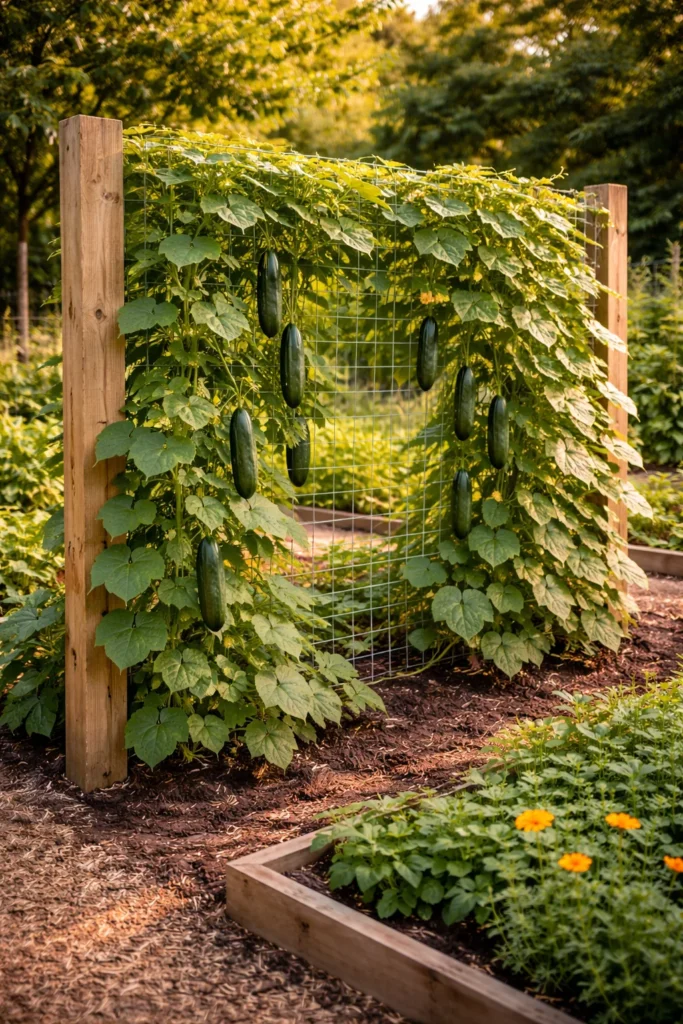
7. Raised Bed Cucumber Trellis System
The raised bed with an integrated cucumber trellis is the system that serious kitchen gardeners return to season after season because it addresses the two most important factors in cucumber productivity simultaneously. The raised bed provides the perfectly drained, deeply amended, and consistently warm soil that cucumbers thrive in. The integrated trellis immediately above provides the vertical growing surface that maximizes the raised bed’s productivity. Together, the two systems create a growing unit of extraordinary efficiency that produces more cucumbers per square foot of ground area than any other approach available to the home gardener.
Tip: Orient your raised bed and integrated trellis so the trellis runs north to south rather than east to west. A north to south trellis orientation allows both sides of the climbing surface to receive direct sunlight at different times of day, east-facing in the morning and west-facing in the afternoon, maximizing the photosynthesis available to the cucumber vines and producing more vigorous growth and more abundant fruit than a trellis that shades one side throughout the day. Trellis orientation is a small decision with a surprisingly significant productivity impact.
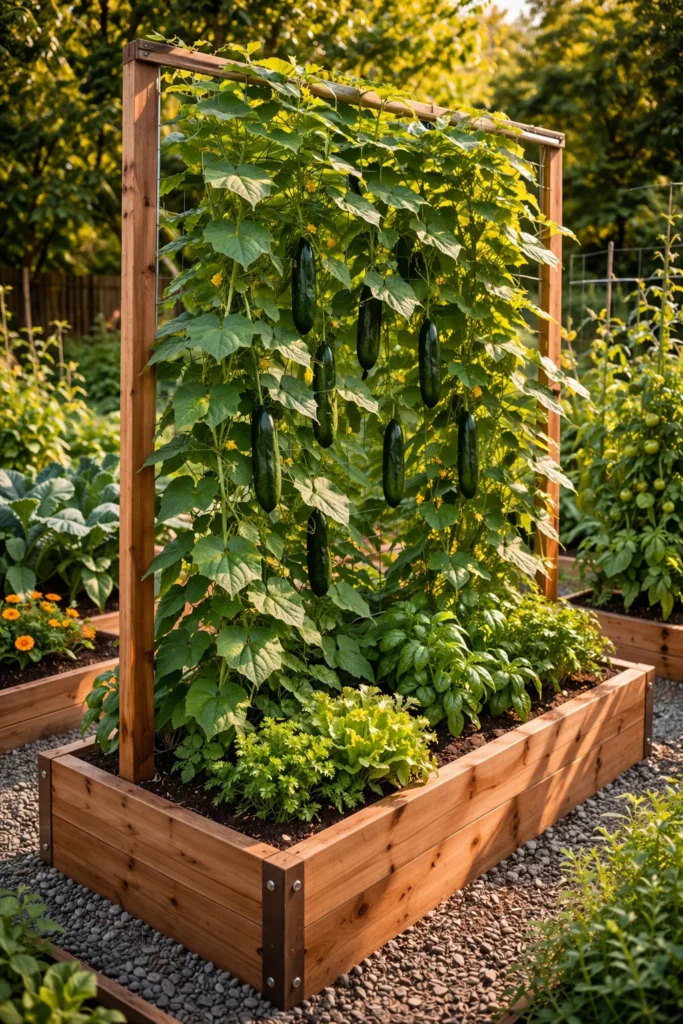
8. String and Post Vertical Trellis
The string and post trellis is the cucumber system of elegant minimalism and organic material philosophy. Natural jute twine is biodegradable, completely compostable at season end, and creates a visual warmth in the garden that synthetic string or wire cannot match. The individual plant-to-string relationship of the vertical string system gives each cucumber vine its own dedicated growing lane, making training, management, and harvest cleaner and more organized than shared mesh or wire systems, and the completely dismountable nature of the string trellis means that crop rotation is simple and that no material is wasted between seasons.
Tip: Wind each cucumber vine around its dedicated vertical string in a clockwise direction from the base upward as it grows, rather than simply allowing the vine to find its own attachment to the string. This deliberate winding creates a secure spiral attachment that supports the vine’s increasing weight as the season progresses and prevents the vine from pulling away from the string during windy weather. A wound vine is significantly more securely supported than a vine that simply leans against a vertical string.
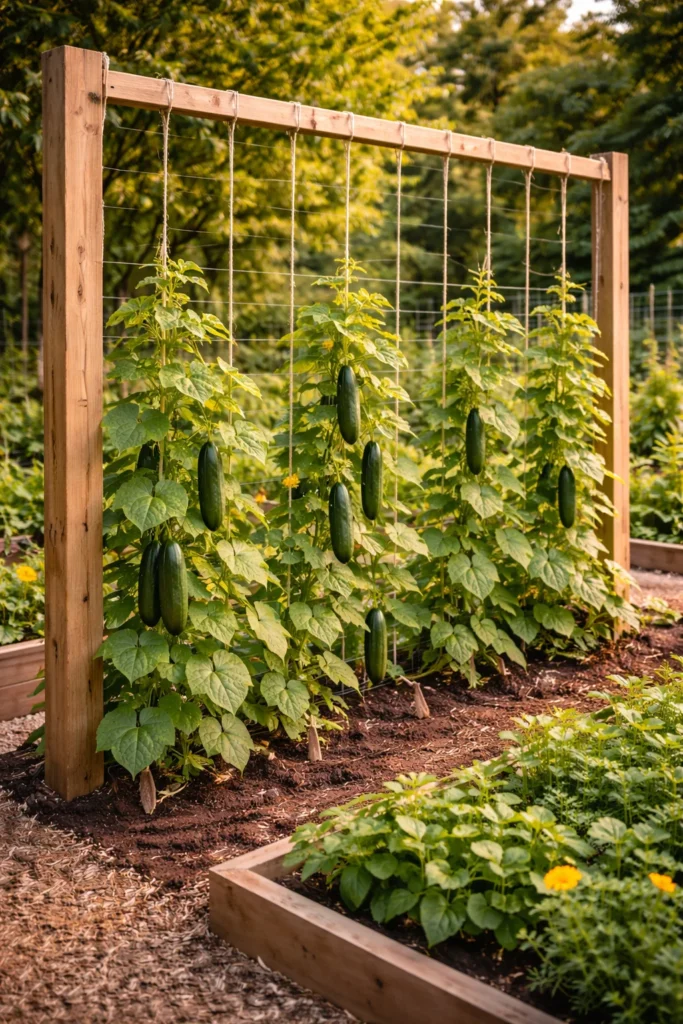
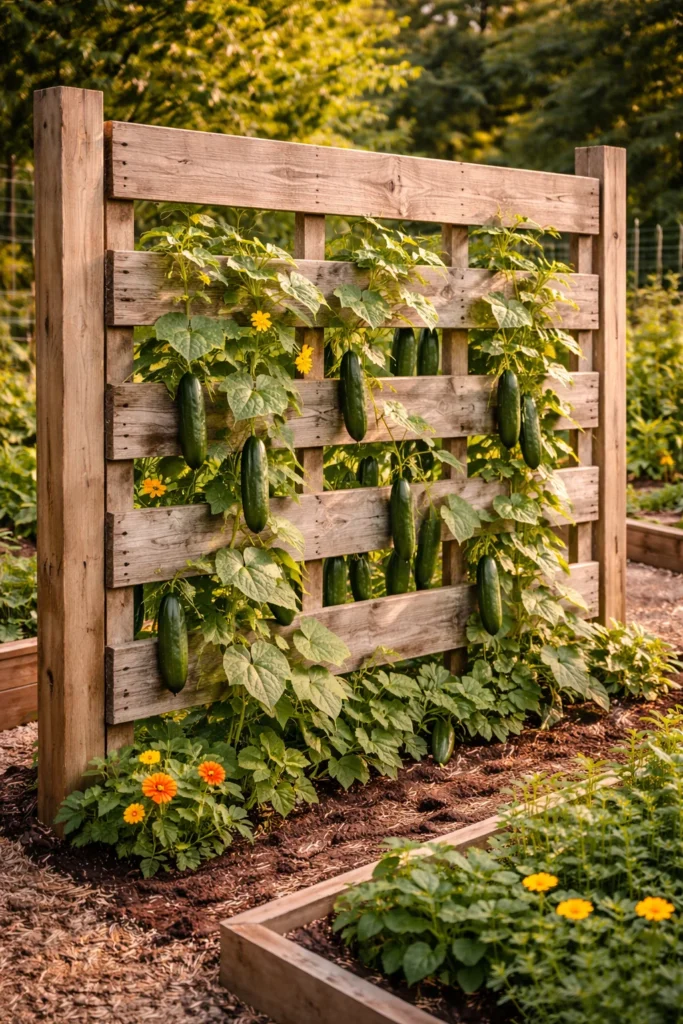
9. Repurposed Pallet Cucumber Trellis
The repurposed pallet trellis is the cucumber support structure for gardeners who believe that the best garden solutions are the ones that cost nothing and waste nothing. A wooden shipping pallet is already a ready-made grid of horizontal slats and vertical rails that is essentially a pre-built garden trellis waiting to be stood upright and used. The sustainability credentials of the repurposed pallet trellis are matched by its genuine productivity, and its rustic weathered character gives the kitchen garden a sense of authentic lived-in resourcefulness that purpose-built structures rarely achieve.
Tip: Always verify that a wooden shipping pallet carries the HT stamp, indicating heat treatment rather than chemical treatment, before using it in a food-growing garden. Chemically treated pallets may contain methyl bromide or other pesticide residues that can leach into the garden soil and potentially contaminate food crops. Heat-treated pallets are completely safe for garden use and are the only pallets that should be used in direct contact with vegetable garden soil. The HT stamp is usually found on one of the pallet’s stringer boards.
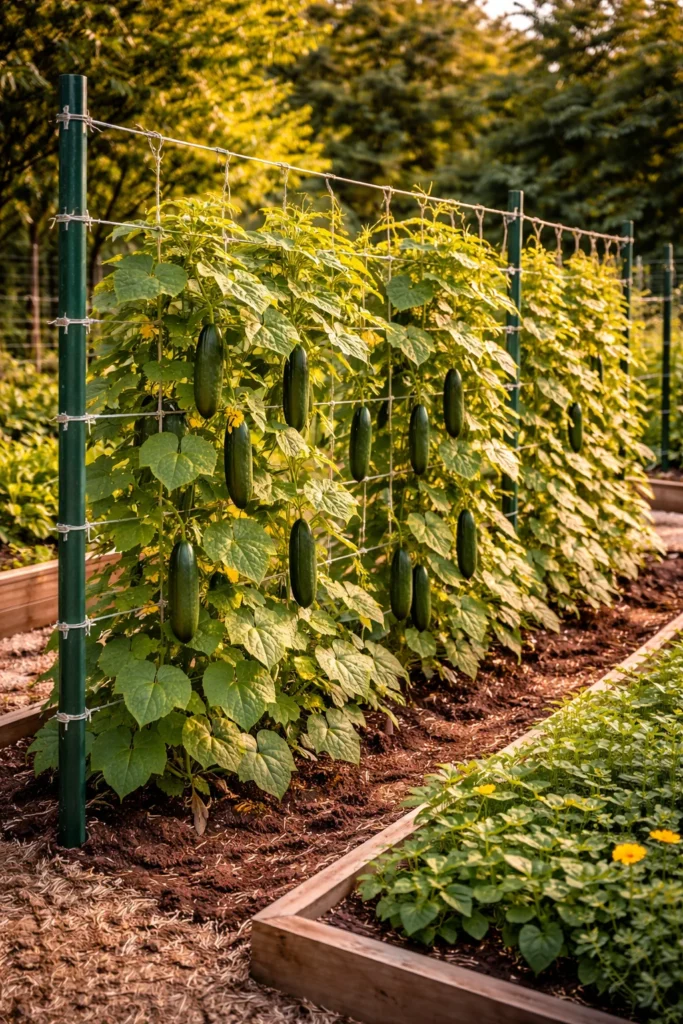
10. Metal T-Post Wire Trellis
The T-post wire trellis is the cucumber support system of the serious and productive kitchen gardener. The driven metal posts hold their position through the worst summer storms, the galvanized wire maintains consistent tension throughout the season regardless of vine weight, and the complete system requires no maintenance and no replacement from season to season beyond the annual removal of spent vines. For gardeners who measure their kitchen garden in rows rather than beds and who grow cucumbers in genuine quantity, the T-post wire system is the most reliable and most cost-effective permanent infrastructure available.
Tip: Use a wire tensioner or small turnbuckle on the end wires of each T-post row to maintain consistent wire tension throughout the growing season. Cucumber vines are surprisingly heavy when in full fruit, and wire that is not properly tensioned will sag under the weight of a mature crop, causing vines to slip downward and reducing the effective growing height of the trellis. Tensioned wire maintains its level position throughout the season, maximizes the growing height available to the vine, and makes harvesting considerably easier.
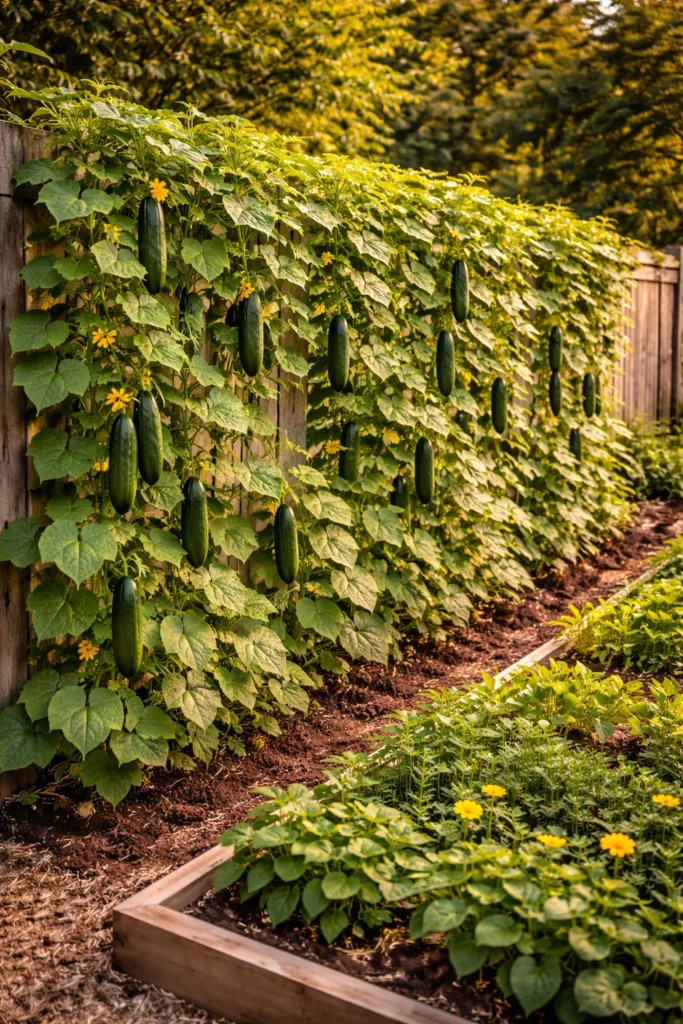
11. Garden Fence Cucumber Trellis
The garden boundary fence is the most underutilized vertical growing surface in the majority of domestic gardens, and training cucumbers along it is the most productive and most space-efficient improvement most kitchen gardeners can make to their existing setup without buying or building a single additional structure. The fence is already there, it is already stable, and with the addition of a few horizontal training wires or the attachment of a simple netting panel to its face, it becomes one of the longest and most productive cucumber growing surfaces available in any garden.
Tip: Choose the south-facing or warmest-facing section of your garden boundary fence for cucumber training rather than any other section. Cucumbers are heat-loving crops that produce most prolifically on the warmest available growing surface, and a south-facing fence collects and retains warmth throughout the day in a way that creates a significantly more productive growing microclimate than a north or east-facing fence section. The orientation of your fence trellis is one of the most important productivity decisions you can make for your cucumber crop.
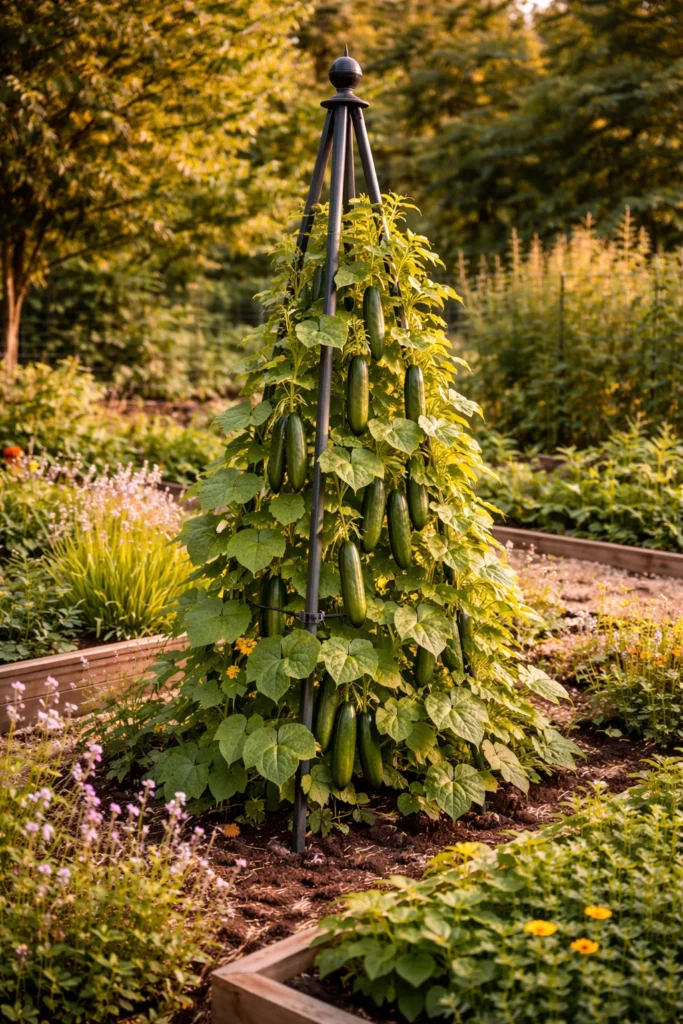
12. Decorative Obelisk Cucumber Support
The garden obelisk is the cucumber trellis for gardeners who care as much about the beauty of their kitchen garden as its productivity, and who see no reason why the two values should ever be in conflict. A well-chosen metal or wooden obelisk in a classical tapered pyramid form is a genuine garden architectural feature in its own right, beautiful even before the cucumber vine begins to climb it, and extraordinary when the vine reaches the finial and the structure is completely colonized with green foliage and hanging fruit. It is the cucumber support that justifies its presence in the garden in every season of the year.
Tip: Position the obelisk toward the back of a border or raised bed rather than at the center or front, even though the trellis-as-focal-point instinct suggests the center. Positioned at the back, the obelisk is visible above lower planting in front of it and creates a layered border composition of genuine garden design quality. Positioned at the center, it divides the border and makes access to both sides difficult. The back-of-border obelisk placement is both the most productive and the most visually satisfying positioning decision.
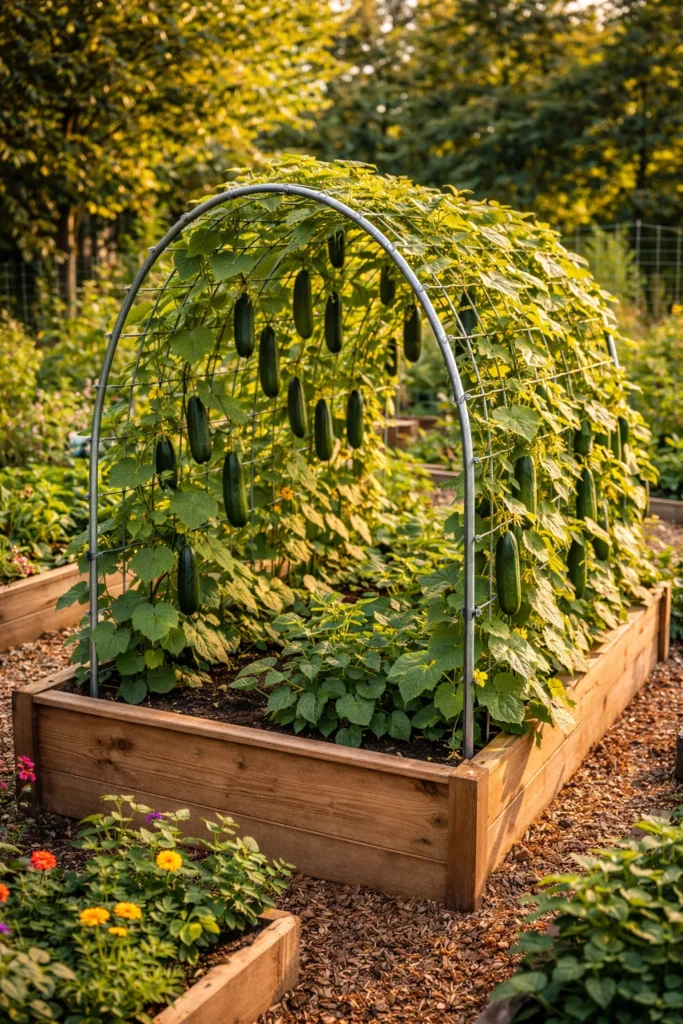
13. Cattle Panel Raised Bed Hoop
The cattle panel raised bed hoop is the most self-contained and most space-efficient cucumber trellis system available for the raised bed gardener. By anchoring both ends of a curved cattle panel directly to the raised bed frame itself, the hoop requires no external posts, no ground anchoring, and no additional support structure. Everything the trellis needs to stand and perform is already contained within the raised bed footprint, and the arch form it creates above the bed is both visually beautiful and functionally brilliant.
Tip: Use the interior arch space of the cattle panel hoop as a microclimate management tool as well as a growing structure. In early spring, drape a single layer of frost fleece over the hoop to create a cloche that protects newly planted cucumber seedlings from late frosts and extends the growing season by two to three weeks. In midsummer, drape a single layer of shade cloth over the end facing the afternoon sun to protect young fruit from sunscald during the hottest weeks. The hoop structure makes both season extension and sun protection simple, inexpensive, and immediately available.
14. Twine Zigzag Trellis System
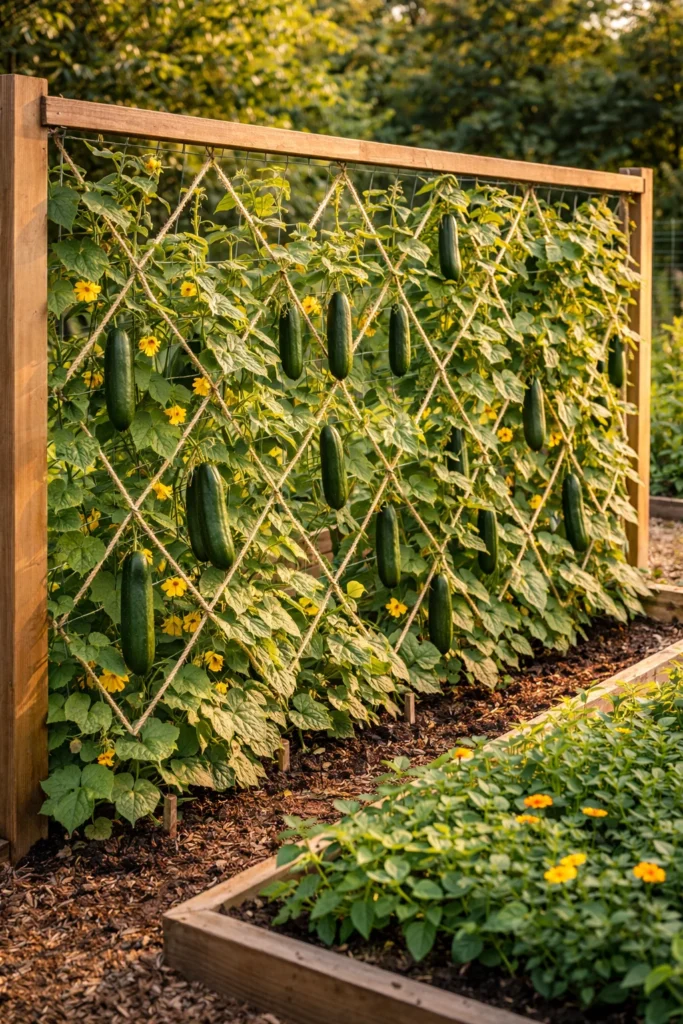
The zigzag twine trellis is the cucumber support system for gardeners who understand that the diagonal growing angle it creates is not just visually more interesting than a vertical string system but functionally more productive. When a cucumber vine grows diagonally rather than vertically, it naturally tends to produce more lateral side shoots at every change of growing direction, and more lateral shoots means more flowering sites and ultimately more fruit per vine. The zigzag system produces more cucumbers from the same number of plants than a purely vertical string system, and it looks considerably more interesting doing it.
Tip: Refresh the zigzag twine completely at the end of each growing season rather than attempting to reuse the same strings in the following year. Natural jute twine degrades over a growing season and will not have sufficient strength for a second year of vine support without significant risk of breaking under fruit weight. Replacing the strings completely each spring takes less than thirty minutes for a standard bed length, costs very little, and ensures that the trellis system provides consistent and reliable vine support throughout the complete following season.
15. Tipi Style Natural Branch Trellis
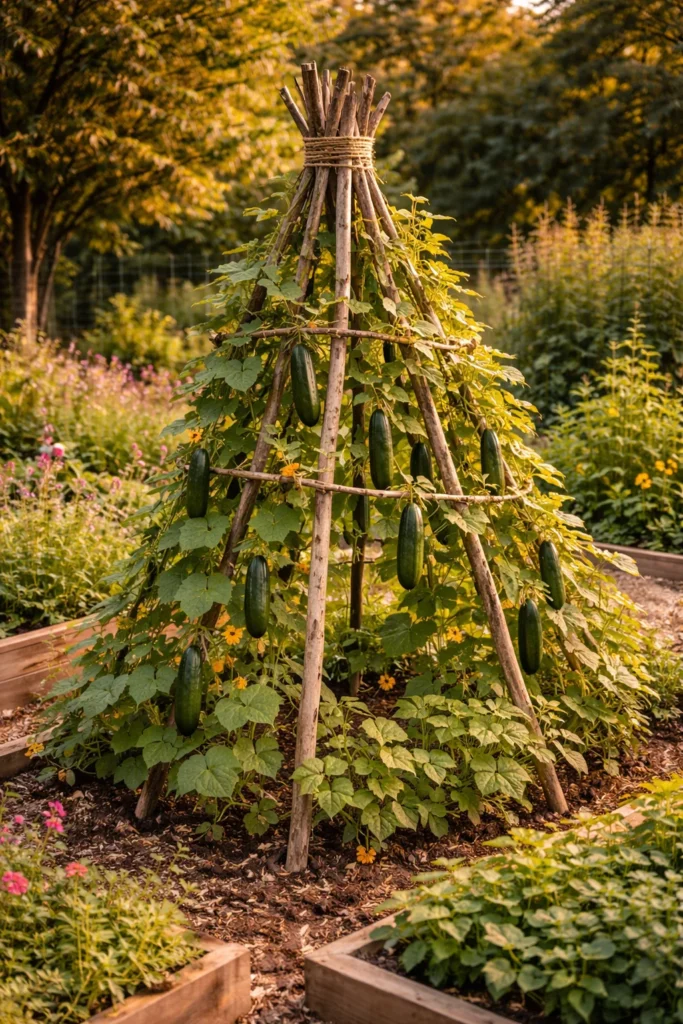
The natural branch tipi is the cucumber trellis for gardeners who find beauty in the imperfect, value in the foraged, and genuine satisfaction in using only what the land around them already provides. There is no more honest garden structure available than one made entirely from branches cut from the surrounding woodland, and there is no cucumber trellis that improves more beautifully with age as the natural wood weathers, the bark roughens further, and the irregular branch form becomes more deeply integrated into the garden landscape around it.
Tip: Harvest branches for the natural tipi trellis in late winter or early spring when the sap is low and the wood is at its driest and most stable. Branches harvested during the growing season contain high moisture levels that cause rapid splitting, cracking, and decay when the branch is cut and used as a support structure. Winter-harvested branches dry and cure naturally after cutting, resulting in a more durable, more stable, and longer-lasting natural trellis structure that will serve productively for two to three growing seasons before needing replacement.
Conclusion
A cucumber trellis is not a gardening luxury or an optional extra. For any gardener growing cucumbers with genuine commitment to productivity, plant health, fruit quality, and garden space efficiency, a vertical trellis system is the single most important growing decision available after the choice of variety and soil preparation.
The fifteen ideas in this post cover every material from natural foraged branches to galvanized metal cattle panels, every construction approach from a thirty-minute bamboo teepee to a permanent T-post wire installation, every garden context from a single raised bed to a long in-ground kitchen garden row, and every aesthetic from the rustic and charming to the clean and contemporary.
What they all share is the fundamental principle that cucumber vines grow upward given the opportunity to do so, and that giving them that opportunity, on whatever structure suits your garden best, produces healthier plants, more abundant fruit, fewer disease problems, and a more beautiful and more productive kitchen garden in every season you grow them.
Choose the trellis that suits your space, your budget, and your sense of the garden you want to grow. Build it before your cucumber seedlings need it. And then stand back and watch what happens when a cucumber vine finally has exactly the support it was always going to make the most of.