Farmhouse living room decor is the American interior aesthetic that has endured longer, spread further, and connected more deeply with more people than almost any other residential design style of the past twenty years. And the reason for that endurance is not difficult to understand. The farmhouse living room does not aspire to impress. It aspires to welcome. It does not try to communicate sophistication or exclusivity. It communicates warmth, honesty, and the genuine domestic pleasure of a room that was made for the people who live in it rather than for the admiration of people passing through.
At its heart, the farmhouse living room is built from a very small number of genuinely beautiful principles. Natural materials, wood, linen, jute, cotton, and ceramic, chosen for their honest organic quality rather than their manufactured perfection. A warm neutral palette of white, cream, and natural wood tones that creates a backdrop of genuine calm and genuine welcome. Practical objects given decorative dignity, the galvanized bucket that holds dried stems, the creamware pitcher that holds wildflowers, the worn cutting board that leans against the kitchen wall because it is beautiful as well as useful. And light, warm Edison bulb light and generous natural daylight, that makes everything within the room glow with the warmth and the intimacy that the farmhouse aesthetic has always been most essentially about.
But farmhouse living room decor is also, as these fifteen ideas demonstrate, a remarkably diverse and adaptable aesthetic. It encompasses the clean lines and matte black accents of the modern farmhouse, the deep forest green walls and amber lamp pools of the dark moody farmhouse, the botanical abundance of the cottagecore farmhouse, the historical character of the vintage collected farmhouse, and the seasonal joy of the fall-decorated farmhouse. The farmhouse living room is not one look. It is one set of values, expressed in fifteen genuinely different ways that share the same fundamental conviction about what a living room should feel like.
These 15 farmhouse living room decor ideas cover every farmhouse aesthetic direction, every room size, every budget, and every personal interpretation of what the farmhouse living room can and should be. Whether you are starting from scratch or refreshing an existing space, whether your farmhouse preference runs toward the purely traditional or the more contemporary, whether you want a complete room transformation or a single styling idea that will make your existing room feel more genuinely farmhouse, this list has the idea that will make your living room feel most genuinely like home.
1. Classic White Shiplap Farmhouse Living Room
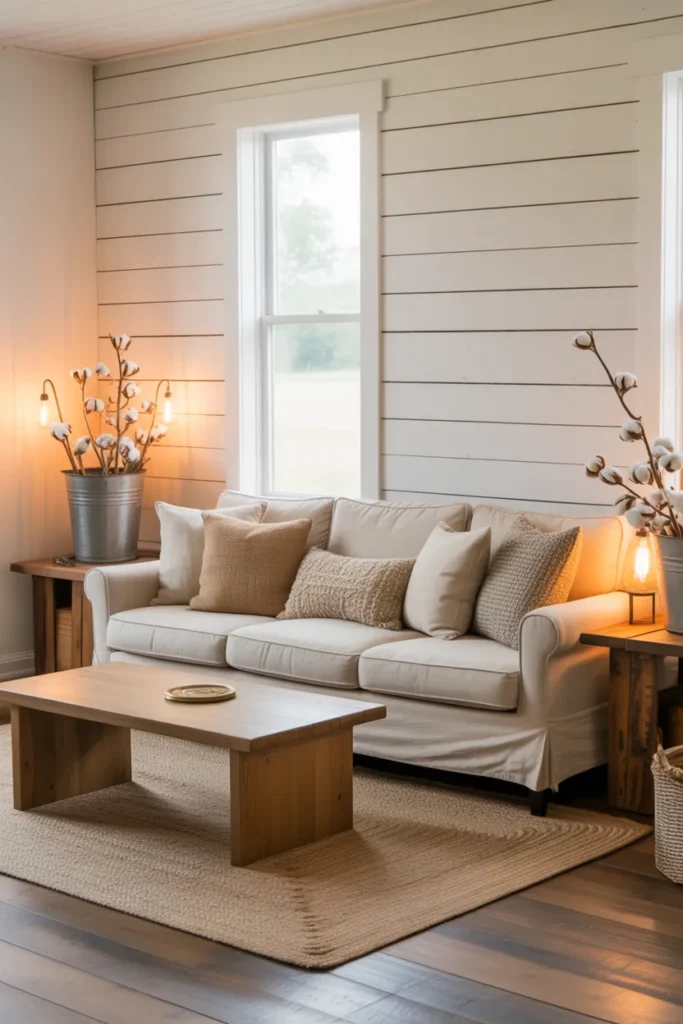
A white shiplap farmhouse living room is the most architecturally authentic expression of the American farmhouse interior aesthetic, because shiplap, with its origins in actual farmhouse and coastal building construction, is the material that connects the interior most directly and most honestly to the building tradition it references. White shiplap on the sofa wall does not look like a decorating trend. It looks like the house was always built this way, and that quality of apparent permanence and material authenticity is the foundation of everything the farmhouse living room is meant to achieve.
Tip: Apply the white shiplap to the single sofa feature wall only, with flat white paint on the remaining three walls, for the most architecturally balanced and the most visually impactful farmhouse living room result. Full-room shiplap on all four walls creates a visual density that can feel more like a cabin than a farmhouse living room, while a single shiplap feature wall creates a defined architectural statement that gives the room its farmhouse character without overwhelming the space. The single shiplap wall is the most frequently used and the most consistently beautiful farmhouse wall treatment application in residential design.
2. Rustic Beam and Linen Farmhouse Living Room
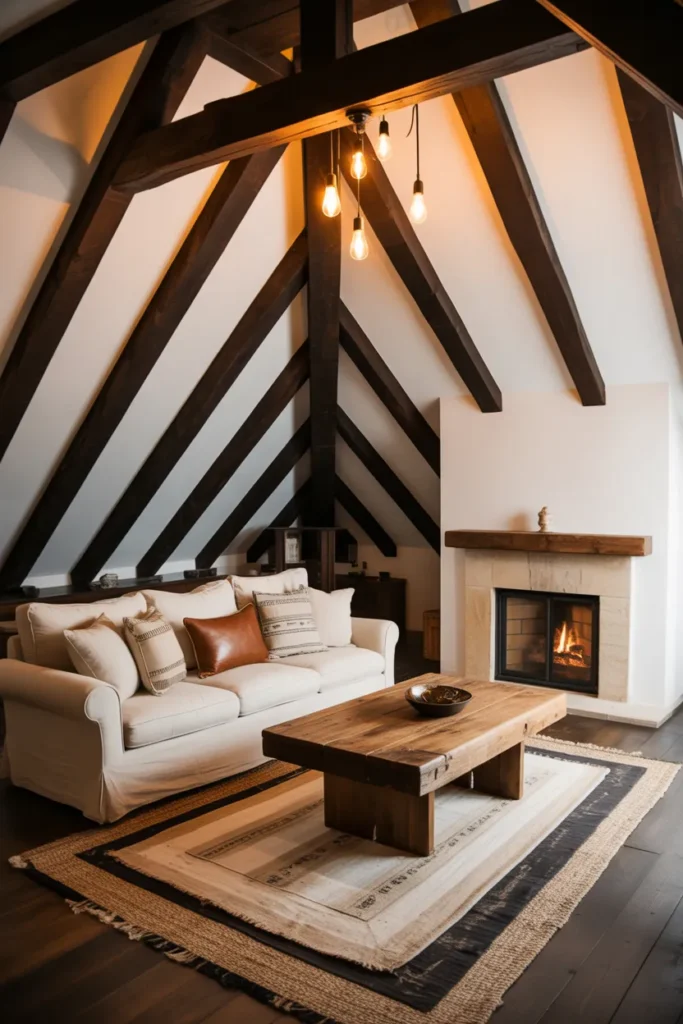
A rustic beam and linen farmhouse living room is the farmhouse aesthetic expressed through its most powerful architectural element, the exposed structural ceiling beam, which carries more historical weight and more material warmth than any other single element available in a farmhouse interior. The beam is not simply a decorative addition. It is a structural reminder of how the farmhouse was built, of the material processes that created it, and of the generations of domestic life that took place beneath it. A living room with genuine or genuinely convincing exposed beams overhead is a living room that exists within a historical architectural narrative that makes it feel more permanently and more authentically beautiful.
Tip: Pair exposed ceiling beams with a linen sofa in the lightest available cream or oatmeal tone for the most beautiful farmhouse living room beam-and-textile combination. The pale linen sofa provides maximum contrast against the dark beam overhead and the warm plaster between the beams, creating a living room composition of genuine visual depth where the ceiling architecture and the upholstered furniture exist in a beautifully balanced relationship of dark and light. A dark sofa beneath dark beams loses this defining visual relationship and reduces the architectural impact of the overhead beams significantly.
3. Modern Farmhouse Living Room
A modern farmhouse living room is the design approach that most honestly addresses the challenge facing anyone who loves the farmhouse aesthetic but finds the more traditional expressions of it slightly at odds with the clean visual sensibility of contemporary life. The modern farmhouse does not abandon the warmth, the natural materials, or the honest domestic quality of the traditional farmhouse aesthetic. It edits them, removes the decorative excess, straightens the lines, adds the matte black accent, and produces a farmhouse living room of genuine contemporary relevance and genuine farmhouse warmth that neither aesthetic achieves fully on its own terms.
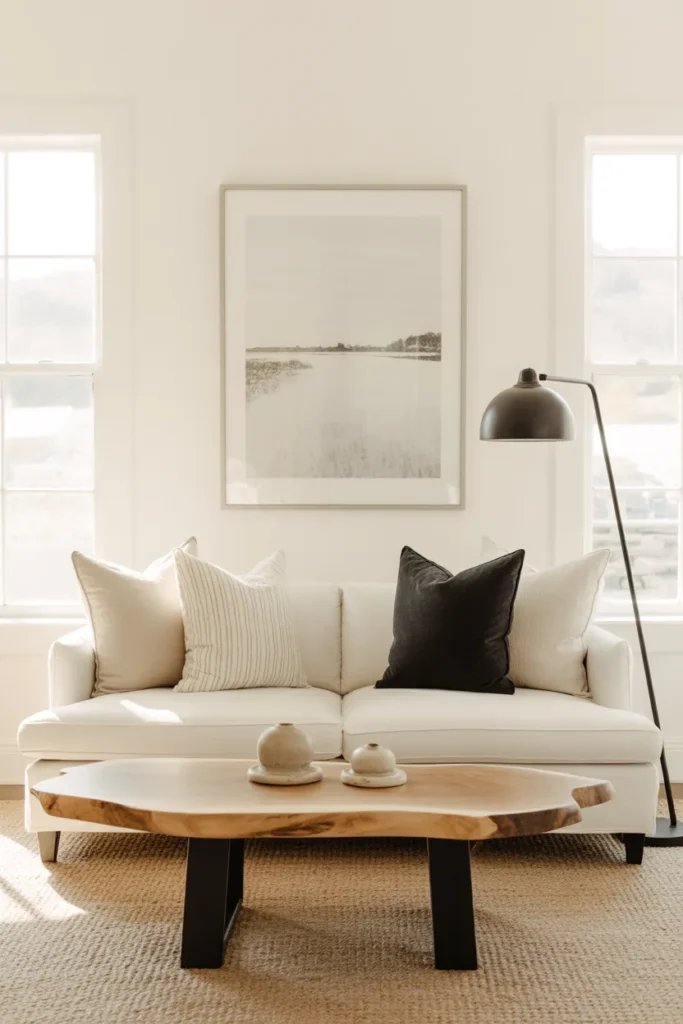
Tip: Limit the modern farmhouse living room to a maximum of three decorative objects on any single surface and two decorative objects on the coffee table. The modern farmhouse aesthetic achieves its distinctive quality of clean warmth through the discipline of genuine restraint, and the surfaces in a modern farmhouse room that are fully cleared, with only two or three genuinely considered objects on them, consistently look more beautiful, more intentionally designed, and more genuinely modern farmhouse than the same surfaces loaded with the decorative abundance that traditional farmhouse styling allows. Restraint is the single most important quality in a modern farmhouse living room.
Also Explore
21 Spring Living Room Decor Ideas That Instantly Brighten Your Home
27 Small Living Room Decorating Ideas That Make Every Inch Count
15 Living Room Sofa Ideas That Make Every Space Feel Complete
14 Boho Living Room Decor Ideas That Feel Warm Free and Effortlessly Cool
4. Cozy Farmhouse Living Room with Fireplace
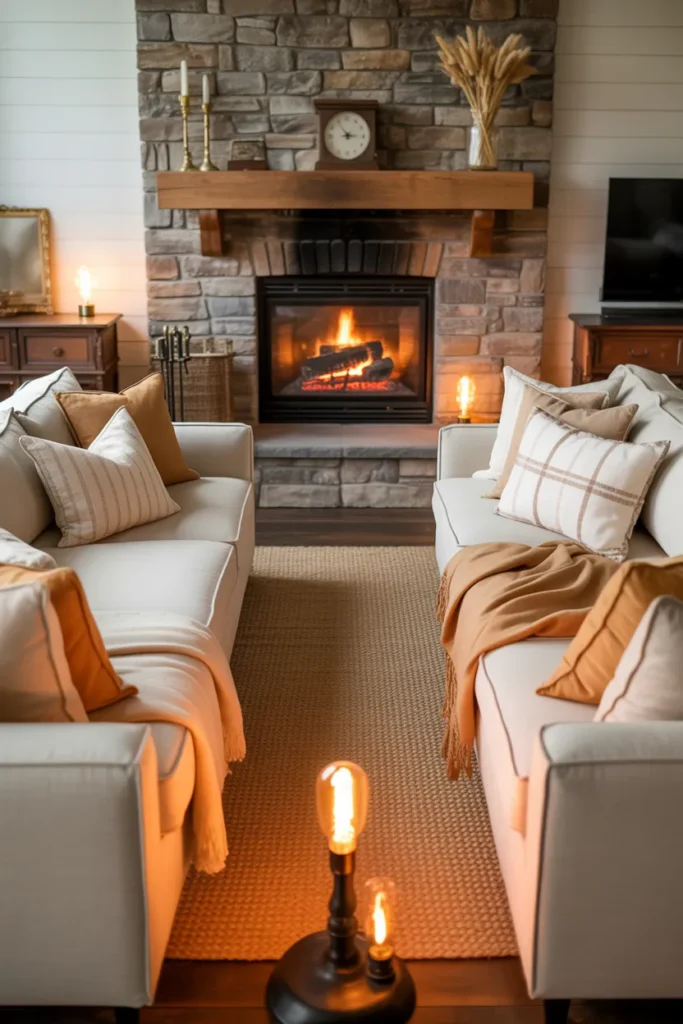
A cozy farmhouse living room with a fireplace is the most quintessentially farmhouse and the most universally beloved domestic interior arrangement available, because the fireplace has always been the literal and symbolic heart of the farmhouse home. In the original American farmhouse, the hearth was not a decorative feature. It was the center of heat, cooking, light, and family gathering that made the farm dwelling habitable and liveable throughout the long cold months of the agricultural year. A farmhouse living room with a working fireplace honors that original domestic function and creates a room of genuine and daily warmth that is impossible to replicate through any other single design decision.
Tip: Place the sofa closer to the fireplace than conventional furniture arrangement guidelines suggest, approximately one point five to two meters from the fireplace opening rather than the more conventional two point five to three meters, for the most genuinely cozy farmhouse fireplace living room quality. The warmth, the light, and the sound of a farmhouse fireplace are all qualities that diminish with distance, and a sofa positioned closer to the fire creates a seating experience of genuine warmth and intimate fireplace connection that a conventionally positioned sofa simply does not provide. The closer position is not a design rule violation. It is a genuine farmhouse cozy wisdom that every person who has sat close to a farmhouse fire instinctively understands.
5. Neutral Farmhouse Living Room Palette
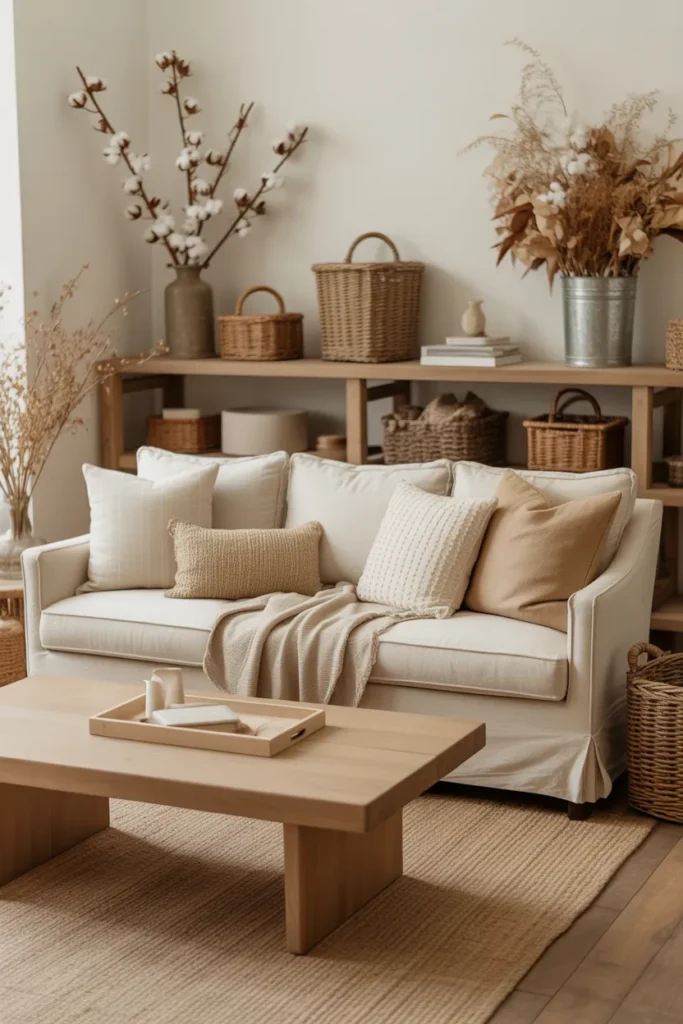
A neutral farmhouse living room palette is the most sophisticated and the most enduringly beautiful expression of the farmhouse aesthetic, because it requires genuine understanding of how organic natural materials create visual richness through texture rather than through color, and the rooms that achieve this understanding consistently produce living spaces of extraordinary calm and genuine material beauty that color-reliant farmhouse interpretations cannot match for quiet sustained quality. A neutral farmhouse living room is not a room without interest. It is a room whose interest is entirely textural, entirely material, and entirely genuine.
Tip: Invest in genuinely high-quality natural material textiles throughout a neutral farmhouse living room rather than substituting synthetic alternatives that approximate the natural aesthetic at a lower price. In a neutral room where color plays no role in creating visual interest, the physical quality of the materials, the weight of the linen, the weave density of the jute, the softness of the wool knit, and the surface texture of the natural cotton, becomes the room’s complete decorative vocabulary. Low-quality synthetic textiles in neutral tones produce a room that looks pale and flat. High-quality natural textiles in the same neutral tones produce a room of genuine organic richness and material sophistication. The quality of the material is the decoration.
6. Farmhouse Living Room Gallery Wall
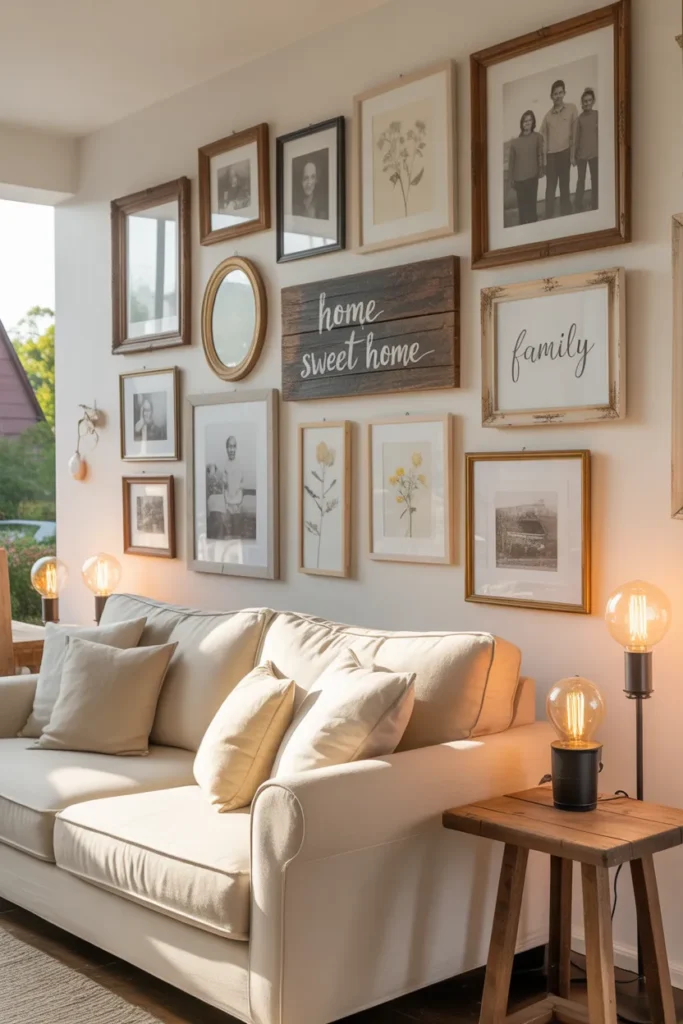
A farmhouse living room gallery wall is the decorating decision that most directly and most personally connects the room to the specific family and the specific life being lived within it. A gallery wall of genuine family photographs, real botanical prints from the garden, an actual hand-lettered verse that means something specific to the household, and a small mirror inherited from a grandparent is a wall that belongs completely and irrevocably to the family that assembled it. No other decorating gesture in the farmhouse living room creates this quality of specific and genuine domestic identity.
Tip: Include at least one genuinely handmade element within the farmhouse gallery wall, whether a hand-lettered sign on reclaimed wood, a pressed botanical print made from garden flowers, a child’s framed drawing, or a hand-stitched textile small enough to be framed. The handmade element does not need to be technically accomplished. It needs to be genuinely made by someone who lives in the house, because that quality of personal making is precisely the quality that transforms a gallery wall from a collection of purchased decorations into a genuine expression of the household’s character and creative life. The handmade piece is always the one gallery wall element that visitors notice most and remember longest.
7. Dark Moody Farmhouse Living Room
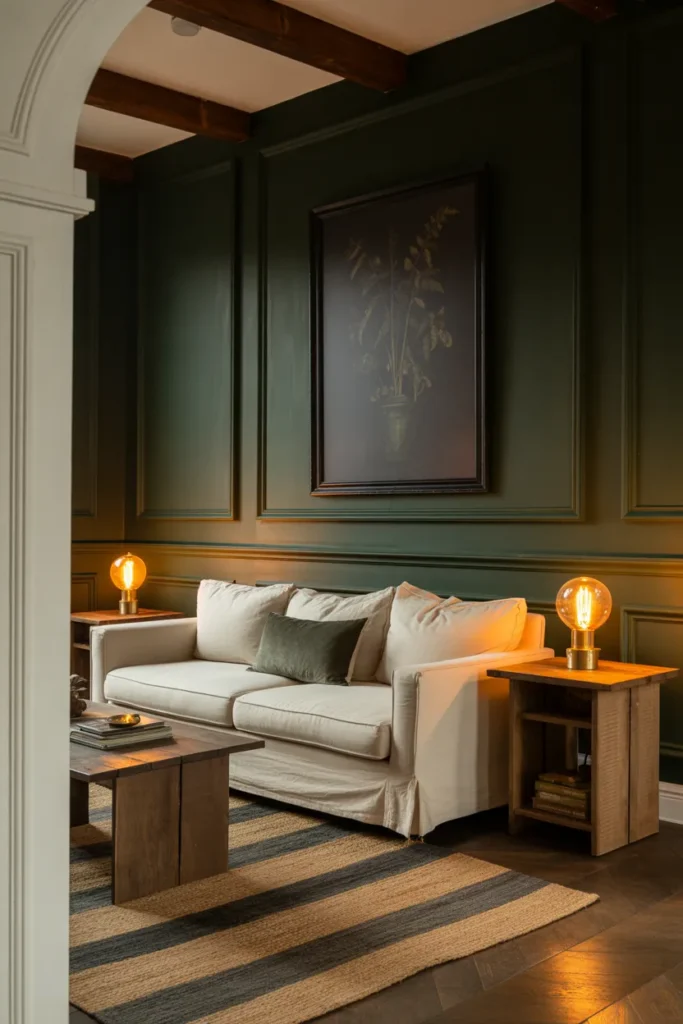
A dark moody farmhouse living room is the most pleasantly surprising interpretation on this list for most people who assume the farmhouse aesthetic is exclusively a white-and-cream proposition. Deep forest green walls with white trim, warm Edison lamp light, a cream sofa that glows against the dark wall, and the honest natural materials of the farmhouse tradition in a dramatic dark envelope create a farmhouse living room of extraordinary atmospheric confidence and genuine beauty that challenges every assumption about what farmhouse decor can look like and consistently wins over everyone who encounters it.
Tip: Maintain the crisp white painted trim throughout a dark moody farmhouse living room, on all baseboards, door frames, window surrounds, and crown molding, as the single most important detail that keeps the dark room within the farmhouse aesthetic rather than tipping it into a more generic dark interior. The white trim against the dark wall is a specifically American farmhouse architectural color relationship that communicates farmhouse identity as clearly as shiplap does, and its presence within a dark room is what makes the room feel like a farmhouse living room that chose dark walls rather than a dark room that happens to have farmhouse furniture in it.
8. Farmhouse Living Room with Sliding Barn Door
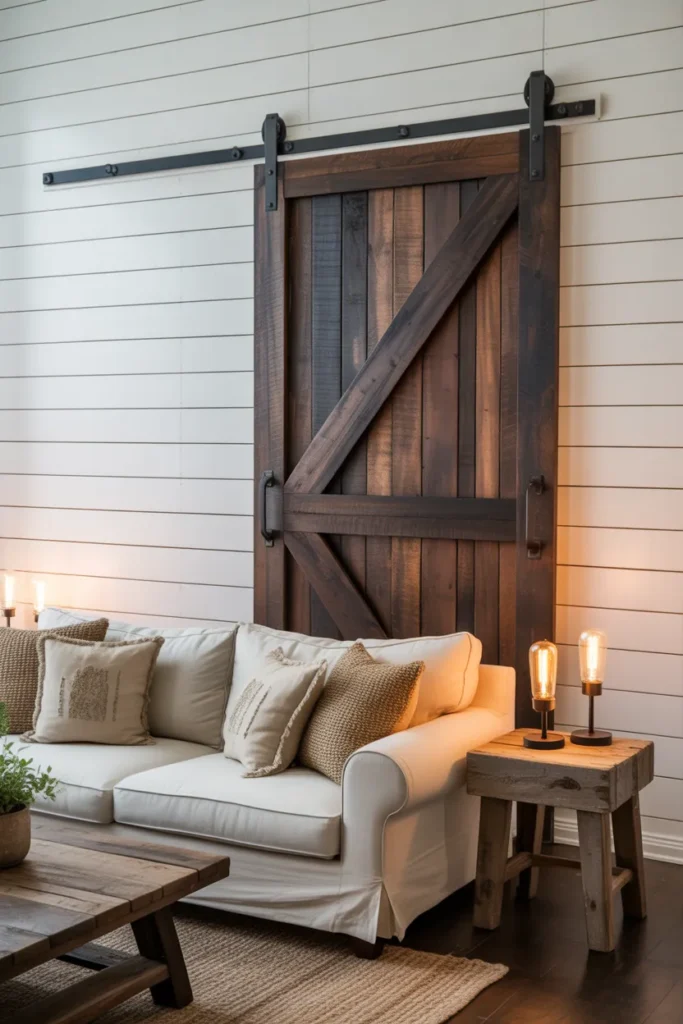
A sliding barn door in a farmhouse living room is the single design element that most universally and most immediately communicates farmhouse identity to anyone who sees it. The barn door requires no explanation, no context, and no interpretation. Every person who has ever seen an American farm building immediately understands what a sliding barn door on interior hardware means, and that immediate cultural recognition is part of the element’s extraordinary and persistent appeal in domestic farmhouse interiors. A living room with a sliding barn door is always a living room that feels genuinely farmhouse before anything else in it has been noticed.
Tip: Source reclaimed barn wood for the sliding door rather than purchasing a new door manufactured to look reclaimed. The genuine surface characteristics of actual barn wood, its weathering patterns, its visible nail holes, its color variation from decades of exposure, and its grain character developed through years of agricultural use, create a sliding door of authentic material beauty that no manufactured reclaimed-look product fully replicates. A genuine reclaimed barn wood door, installed with good quality black metal hardware on a white shiplap wall, is one of the most beautiful and most authentic farmhouse interior statements available in residential design.
9. Vintage Farmhouse Living Room Collection
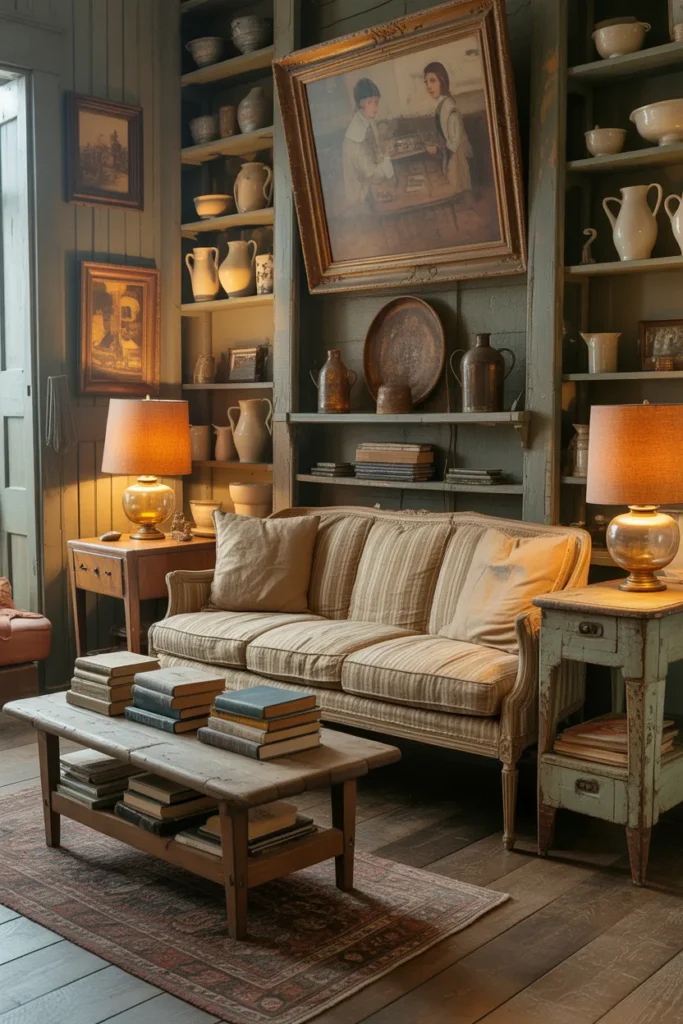
A vintage farmhouse living room collection is the most historically honest and the most genuinely characterful expression of the farmhouse aesthetic, because the original American farmhouse interior was always a collected room rather than a decorated one. Farmhouse families accumulated the objects around them over generations through use, inheritance, making, and trade rather than through purposeful decorating, and the living rooms that resulted from that accumulation had a quality of organic historical depth and genuine personal character that no single-visit decoration project can replicate. The vintage farmhouse living room honors that accumulation as the highest form of domestic design.
Tip: Resist the urge to over-restore or over-clean vintage farmhouse pieces before incorporating them into the living room collection. The patina of an aged wood surface, the wear marks on a vintage textile, the crazing of an antique ceramic glaze, and the scratches on an inherited painted surface are the physical records of the object’s history, and that history is precisely the quality that makes vintage farmhouse pieces more beautiful and more meaningful than new alternatives. A vintage farmhouse object that has been stripped, refinished, and returned to apparent newness has lost the specific quality that made it worth incorporating into the collection in the first place.
10. Farmhouse Living Room Bookshelf Styling
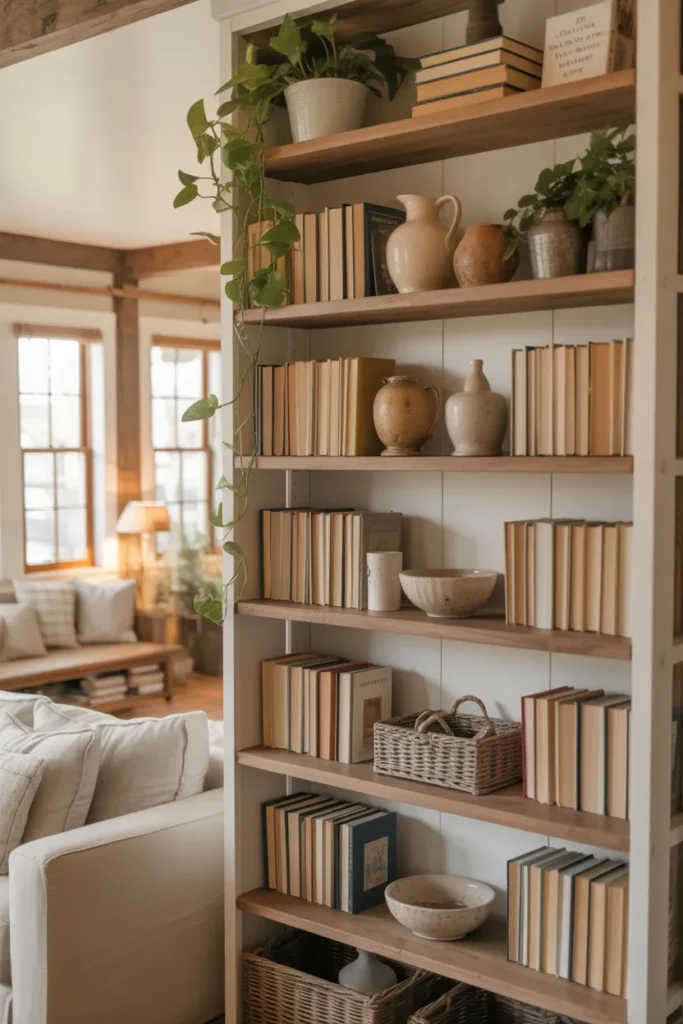
A beautifully styled farmhouse bookshelf is the living room’s most consistently rewarding and most genuinely personal display surface, because the combination of books that have been genuinely read, ceramics that have been genuinely chosen, and plants that have been genuinely grown and cared for creates a shelf display that reflects the actual intellectual and aesthetic life of the person who assembled it. A farmhouse bookshelf cannot be styled to look genuinely beautiful without the genuine substance of real reading, real collecting, and real caring for living plants, and that requirement for genuine content is what makes the farmhouse bookshelf so personally rewarding to assemble and so genuinely beautiful to look at.
Tip: Organize the books on a farmhouse bookshelf by size rather than by alphabetical order or by subject, with the tallest books at the back of each shelf and the shortest at the front, with occasional horizontal stacks creating depth variation. This size-based organization creates a shelf of genuine visual rhythm and natural order that looks deliberately considered without appearing rigidly systematic, which is the specific combination of apparent intentionality and organic warmth that farmhouse shelf styling most needs to achieve its best quality.
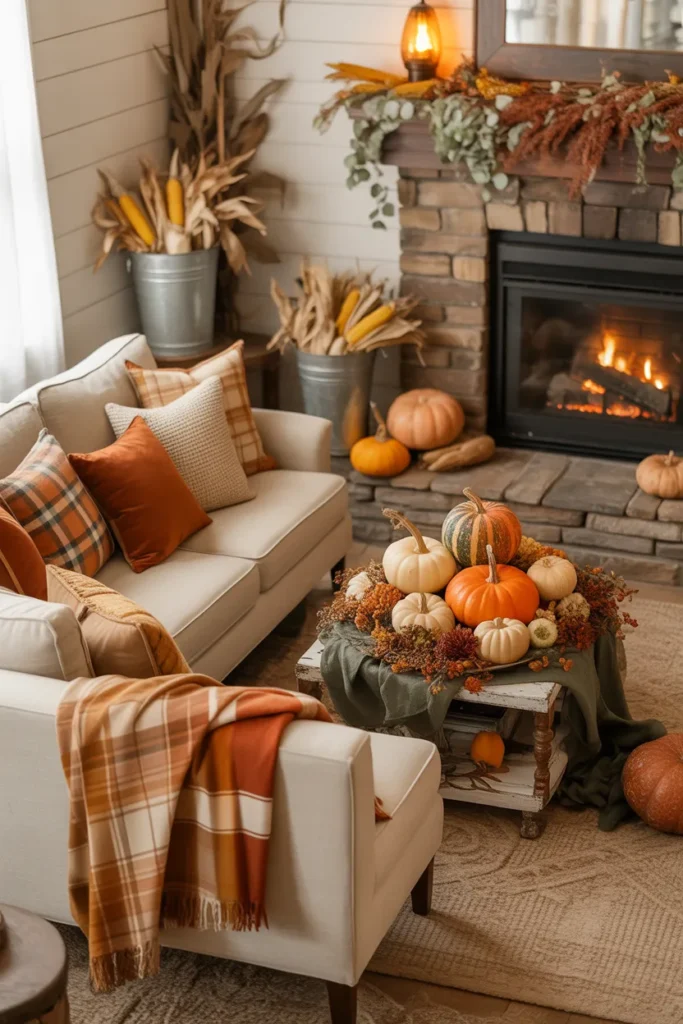
11. Seasonal Fall Farmhouse Living Room
A seasonal fall farmhouse living room is the farmhouse aesthetic’s most joyful and most genuinely seasonal expression, because the connection between the farmhouse tradition and the autumn harvest is both historically deep and visually extraordinary. The farmhouse was literally built around the harvest, and the seasonal decoration of the farmhouse interior with pumpkins, dried corn, fall botanicals, and warm plaid textiles is not a decorating trend but an annual renewal of the most fundamental farmhouse domestic ritual, the celebration of abundance, warmth, and the turning of the year toward winter.
Tip: Begin the transition to fall farmhouse living room styling in the last week of September rather than waiting until October, so the autumnal decoration is in place at the beginning of the season when the quality of the light and the temperature are beginning to change and the room’s warmth and seasonal character are most appreciated and most needed. A farmhouse living room that transitions to its fall decoration in late September creates a complete month of additional autumnal domestic pleasure that October-only decorating misses entirely, and the longer enjoyment of a genuinely beautiful seasonal transition is one of the most genuinely satisfying domestic pleasures available in any home.
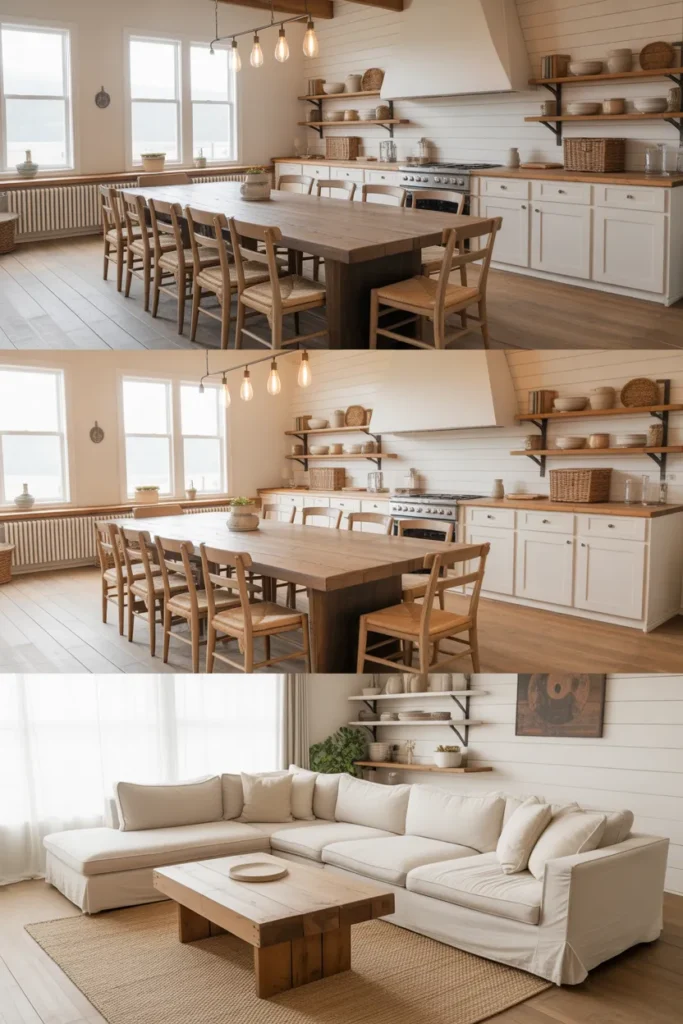
12. Farmhouse Living Room Open Concept
A farmhouse open concept living space is the domestic arrangement that most completely expresses the farmhouse philosophy of gathering, because the farmhouse home was never originally a collection of separated rooms. It was a few generous shared spaces where the family’s entire domestic life, cooking, eating, working, and resting, happened in a continuous and connected proximity that made the home genuinely communal rather than simply co-occupied. The contemporary open concept farmhouse living space honors that original farmhouse spatial philosophy and creates the most genuinely social and the most warmly domestic version of the farmhouse home available in modern residential design.
Tip: Define the living zone within an open concept farmhouse space with a large area rug that is generously oversized relative to the sofa, extending at least forty-five centimeters beyond the front legs of the sofa on all sides, rather than using a rug that simply fits beneath the furniture. An oversized rug creates a visual floor boundary for the living zone that reads as a defined room within the open concept space, creating the sense of living room enclosure and intimate gathering that a too-small rug cannot achieve. The rug is the single most important spatial definition tool in an open concept living room design.
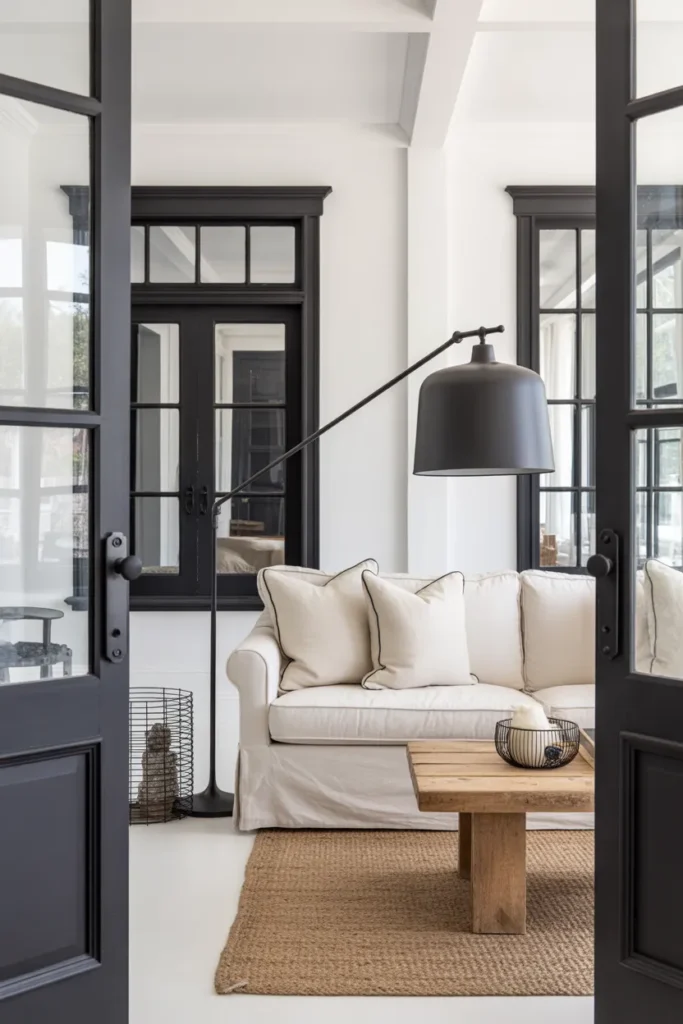
13. Black Accents Farmhouse Living Room
A black accent farmhouse living room is the design decision that demonstrates how a single consistent material choice, applied throughout a room with genuine discipline, can transform the entire visual character of a space without changing a single piece of furniture or a single structural element. The consistent application of matte black to every lamp base, picture frame, curtain rod, window frame, hardware piece, and metal accessory in an otherwise white and natural farmhouse living room creates a graphic visual clarity and a contemporary design confidence that neither the white farmhouse elements nor the matte black accents could achieve independently. The combination is the statement.
Tip: Choose truly matte black rather than satin or semi-gloss black for all farmhouse accent elements. Matte black absorbs light evenly, creating a consistent flat graphic quality across all accent elements that reads as a deliberate and unified design decision throughout the room. Satin or semi-gloss black reflects light differently depending on the angle of viewing, creating variable shine levels across the different accent pieces that make the black elements look like they were purchased separately in slightly different finishes rather than applied as one consistent material accent throughout the room. Finish consistency is the quality control detail that makes a black accent room genuinely beautiful.
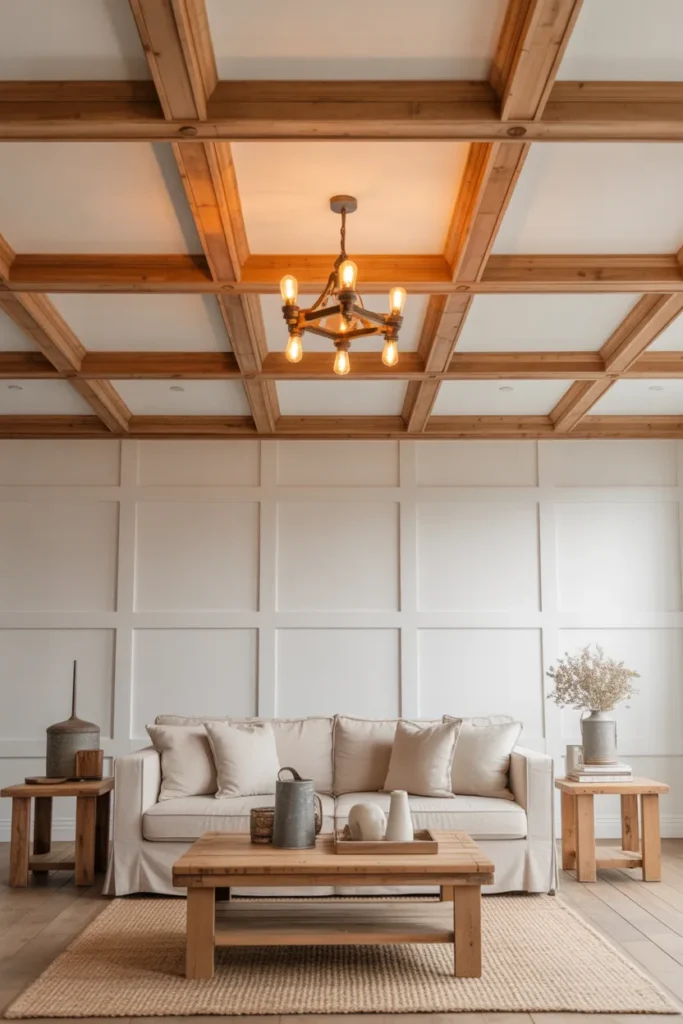
14. Farmhouse Living Room Ceiling Ideas
A beautifully considered farmhouse living room ceiling is the detail that most consistently surprises people with the degree to which it improves the complete room. Most living rooms receive ceiling attention only in the form of a coat of white paint applied during the last decoration project, and the ceiling’s potential as an architectural and decorative surface of genuine beauty goes entirely unexplored. A coffered ceiling, a beadboard ceiling, or a shiplap ceiling in a farmhouse living room transforms the overhead plane from an ignored necessity into the room’s most architecturally distinguished surface, and the warm Edison chandelier hung within it becomes the most beautiful light fixture in the house.
Tip: Choose a farmhouse chandelier or pendant grouping with warm Edison bulbs for the farmhouse living room ceiling that is scaled generously to the room rather than conservatively. Most people undersize their living room chandeliers and pendant lights out of caution, and the result is a light fixture that looks visually inadequate for the ceiling space it occupies. For a farmhouse living room, add fifteen to twenty centimeters to the diameter of the chandelier that would be conventionally recommended for the room size. A generously scaled farmhouse chandelier with visible Edison bulbs creates a ceiling presence of genuine farmhouse architectural warmth and beauty. An undersized one creates a pale ceiling that could have been extraordinary and was not.
15. Cottagecore Farmhouse Living Room
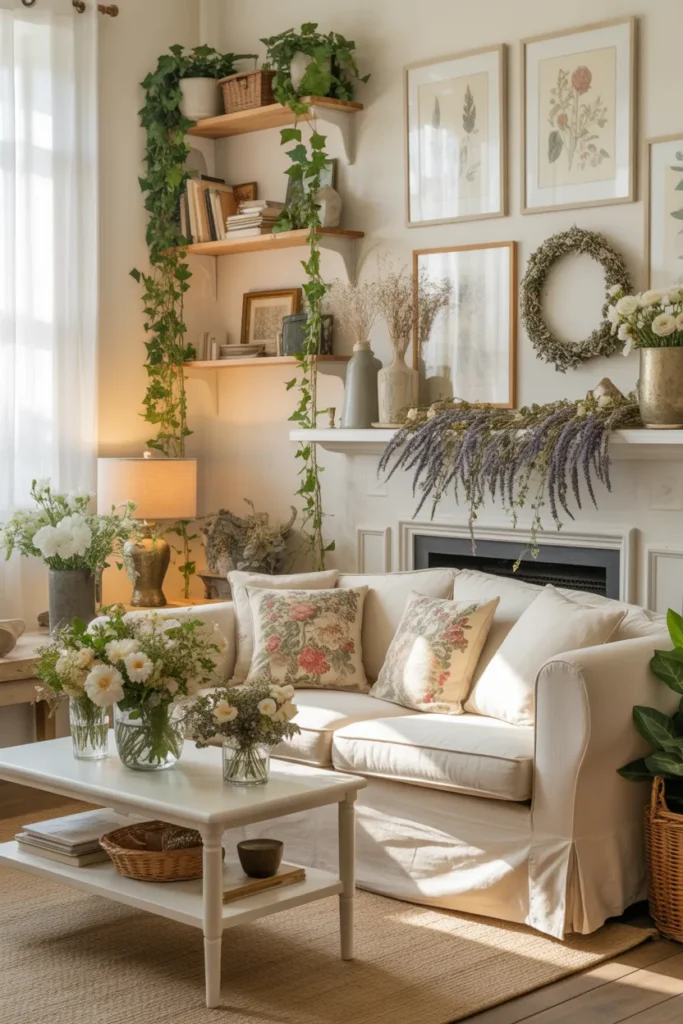
A cottagecore farmhouse living room is the aesthetic for people who find the farmhouse’s most beautiful quality in its historically deep connection to the natural world and who want to express that connection through an abundance of living plants, fresh flowers, dried botanicals, and botanical art that makes the living room feel genuinely alive with the garden around it. The cottagecore farmhouse living room does not simply reference nature as an aesthetic. It brings nature inside in genuinely living, genuinely fragrant, and genuinely seasonal forms that change the quality of the daily experience within the room in ways that illustrated botanicals and fabric prints alone cannot achieve.
Tip: Establish a specific day of the week as the fresh flower day for a cottagecore farmhouse living room, a day when fresh flowers from the garden, the farmers market, or a florist are brought in and arranged in the crockery jugs and glass vases throughout the room. The weekly fresh flower ritual is both a practical maintenance habit and a genuine domestic pleasure that keeps the cottagecore farmhouse living room consistently at its most beautiful and most botanically alive. A cottagecore room with consistently fresh flowers feels genuinely cared for and genuinely alive. The same room with wilting flowers feels abandoned and slightly sad. The weekly flower ritual is the habit that maintains the aesthetic.
Conclusion
The farmhouse living room is, at its most essential, a room that was designed for the people who live in it rather than for anyone else. It prioritizes warmth over impressiveness, honesty over sophistication, comfort over formality, and the genuine pleasure of daily domestic life over the performance of a curated aesthetic identity. These are the qualities that have made farmhouse living room decor the most persistently beloved and the most widely adopted residential interior style of the contemporary period, and they are the qualities that will keep it beautiful and relevant long after the design trends that surrounded it have faded.
The fifteen ideas in this post cover every expression of the farmhouse living room, from the architectural authenticity of the classic white shiplap room to the botanical abundance of the cottagecore interpretation, from the historical depth of the vintage collected room to the graphic confidence of the modern black accent space, from the extraordinary seasonal joy of the fall-decorated room to the meditative calm of the neutral palette living room. What they all share is the core farmhouse conviction that a beautifully designed living room is one that makes every person who enters it feel immediately and completely at home.
Choose the farmhouse living room idea that most genuinely reflects your own sense of home, your own aesthetic preferences, and the specific quality of warmth and welcome that you want your living room to provide. Apply it with the same honest attention to genuine material and genuine purpose that the farmhouse tradition has always valued. And then sit down in the room it creates and experience what every great farmhouse living room ultimately offers: the uncomplicated and entirely genuine pleasure of being somewhere that feels completely, warmly, and permanently like home.