The Japanese garden is not defined by its scale. It is defined by its intention. The Zen master who first raked gravel around a stone was not working in a large garden. The tea ceremony practitioner who designed the roji path to the tea house was working with whatever space was available. The bonsai artist who shaped a tree into a complete landscape in miniature understood that the Japanese garden philosophy does not require acres of land. It requires only the application of precise principles to whatever space exists.
This is the most important and most liberating truth about mini Japanese garden design: the qualities that make a Japanese garden most beautiful, its calm, its simplicity, its natural material honesty, its meditative atmosphere, and its seasonal awareness, are all qualities that are fully achievable at any scale. A tabletop bonsai and stone garden contains the same philosophical depth as a two acre garden with a koi pond and a tea house. A windowsill moss tray with three small stones expresses the same karesansui principle as the largest dry landscape garden in Kyoto. A mini Zen tray garden on a desk delivers the same meditative benefit as a full sand garden in a dedicated outdoor room.
What changes with scale is not the quality of the Japanese garden experience but only the physical size of the vessel that contains it. And in a world where outdoor space is increasingly limited, increasingly urban, and increasingly shared with the practical demands of contemporary life, the ability to create a complete Japanese garden experience in a large bowl, a shallow tray, a window box, a balcony corner, or a small courtyard is not a compromise of the Japanese garden tradition. It is its most genuinely democratic and most widely available expression.
These 13 mini Japanese garden ideas cover every format from the smallest tabletop Zen tray to the most spatially generous small balcony and courtyard installations. Every idea draws from genuine Japanese garden principles and every idea is achievable in the smallest and most practically constrained outdoor and indoor spaces. What they all share is the same fundamental quality: the quality of bringing genuine Japanese garden calm to any space that is given the right materials, the right intention, and the right understanding that in Japanese garden design, less is always, always, the most beautiful kind of more.
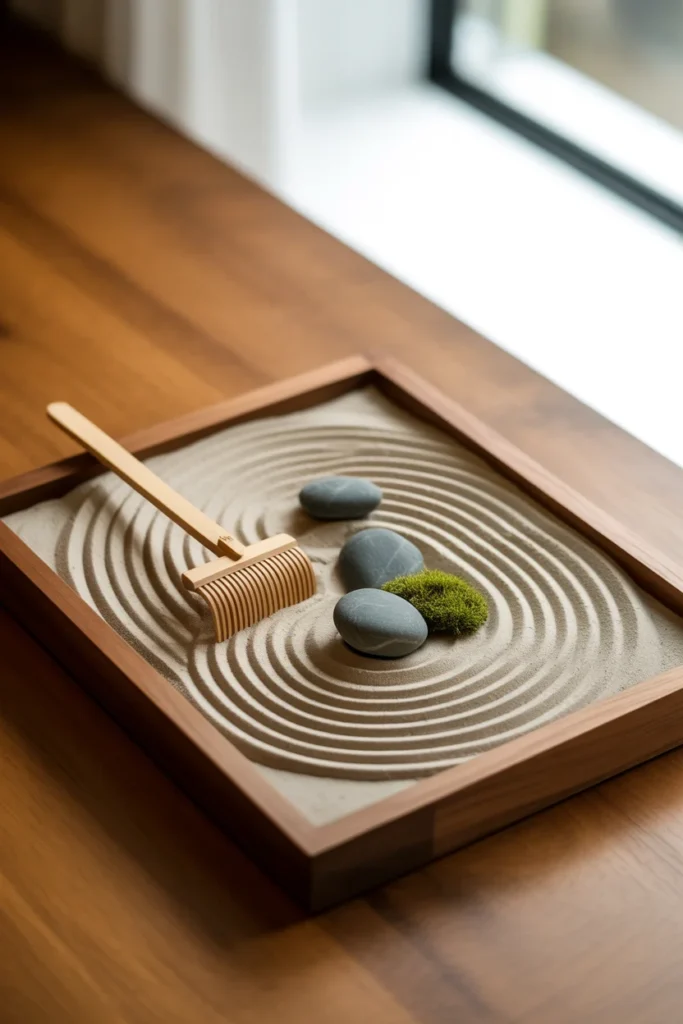
1. Mini Zen Tray Garden
A mini Zen tray garden on the desk or table is the most immediately accessible and most daily practice friendly format of the Japanese garden tradition because it is always within reach, always available for the meditative act of raking, and always present as a calming visual focal point during the working or resting hours of the day. Its scale does not diminish its meditative value. The quality of focused present moment attention that raking the miniature sand pattern requires is identical to the quality that raking a full sized Zen garden requires and the calm that follows is equally genuine.
Tip: Rake the mini tray garden at the same time each day as a consistent daily ritual rather than only when the mood strikes. The consistent daily timing transforms the raking practice from an occasional pleasant activity into a genuine meditative ritual with its own accumulating contemplative value. A mini Zen tray garden that is raked daily for six months develops a relationship between the garden and the person who tends it that occasional raking can never establish. That relationship is the mini garden’s most valuable and most genuinely Japanese quality.
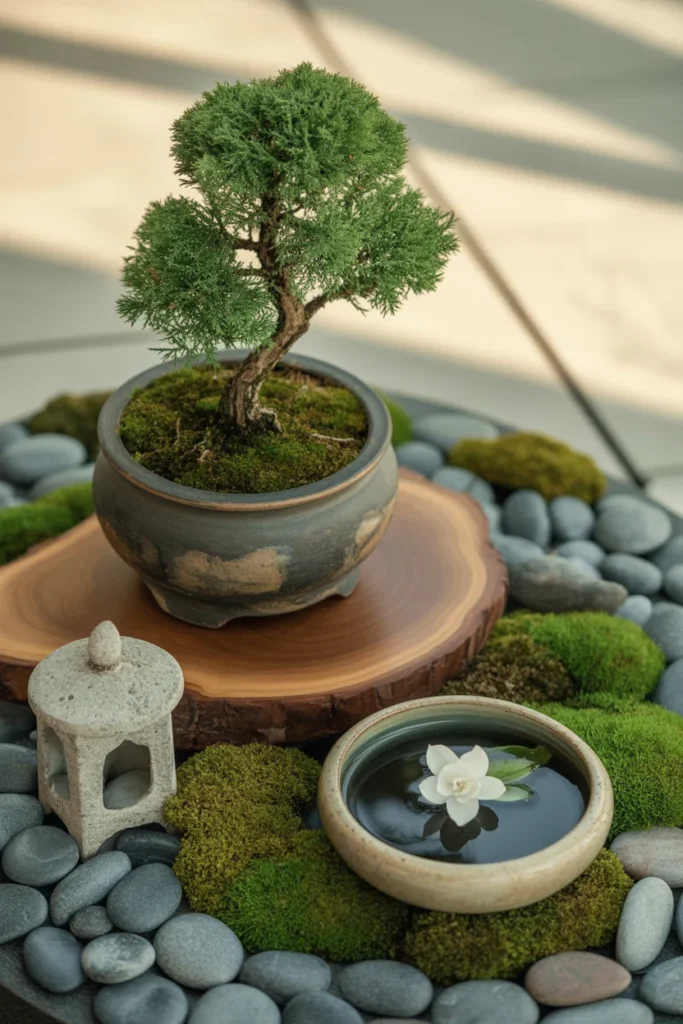
2. Tabletop Bonsai and Stone Garden
A tabletop bonsai and stone garden is the Japanese garden format that most completely combines the living botanical artistry of bonsai cultivation with the mineral calm of Japanese garden stone arrangement at a scale that fits comfortably on any table surface. The bonsai provides seasonal change, living growth, and the evidence of patient human botanical attention. The stone arrangement provides permanent structural calm and the mineral quality of things that change only over geological time. Together they create a complete Japanese garden philosophy in miniature.
Tip: Mist the cushion moss patches in the tabletop bonsai and stone garden daily with a fine spray bottle to maintain their lush living green quality. Cushion moss in an indoor or partially shaded outdoor display environment dries out significantly faster than moss in a fully outdoor garden setting. Daily misting takes less than thirty seconds and maintains the moss at its most lush, most luminous, and most genuinely beautiful green quality. Moss that is allowed to dry completely turns brown and may not recover. Moss that is misted daily remains the most vivid and most beautiful green that any living ground cover can provide at miniature Japanese garden scale.
Read More:-
16 Patio Decor Ideas That Turn Any Outdoor Space Into a Retreat
19 Bathroom Remodel Ideas That Make Every Update Worth Every Penny
15 Farmhouse Living Room Decor Ideas That Make Every Space Feel Like Home
3. Small Balcony Japanese Garden
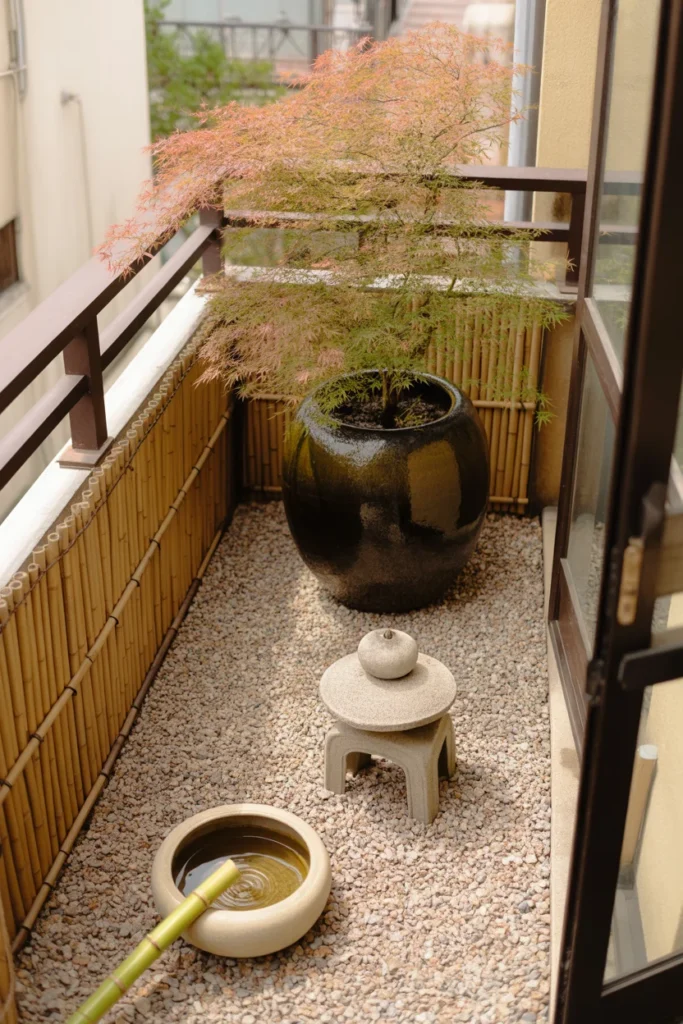
A small balcony Japanese garden that covers the balcony floor with gravel, positions a Japanese maple as the primary botanical focal point, and includes a bamboo screen, a stone lantern, and a ceramic water basin applies every principle of full scale Japanese garden design to a space measured in square meters rather than square meters multiplied by hundreds. The result is not a diminished Japanese garden. It is a complete Japanese garden at a different scale.
Tip: Confirm the load bearing capacity of the balcony with the building engineer or property manager before installing decomposed granite floor covering, large ceramic pots, and a dark wood water basin on the balcony surface. Gravel, ceramic, and water are all significantly heavier per square meter than standard patio furniture, and a balcony that is comfortable for furniture and people may be close to or at its structural limit when those same materials are added as Japanese garden elements. The weight calculation takes five minutes and prevents a structural problem that would be significantly more difficult and expensive to address after installation.
4. Container Water Garden with Lotus
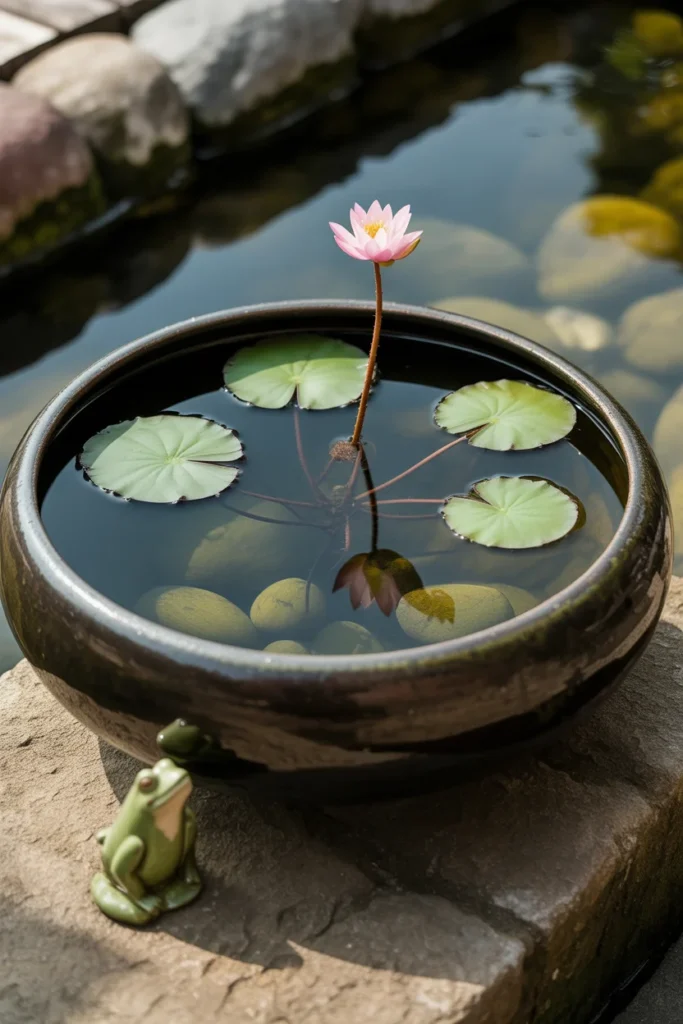
A container lotus water garden is the Japanese garden format that brings the most spiritually significant plant in the Japanese Buddhist garden tradition to any surface large enough to support a single large ceramic bowl. The lotus has been the primary botanical symbol of Buddhist spiritual development for over two thousand years, its ability to rise from muddy water to produce a perfectly pure blossom representing the most important Buddhist metaphor for human spiritual potential. A single lotus in a garden bowl carries that entire philosophical tradition with it.
Tip: Position the container lotus water garden in full direct sunlight for a minimum of six hours daily for the most reliable and most abundant lotus bloom production. Lotus flowers are produced only on plants that receive adequate full sun energy to support the metabolic cost of flowering. A container lotus in partial shade or significant shade may produce healthy foliage but is unlikely to bloom satisfactorily. Full sun is not a preference for the container lotus. It is the essential environmental condition without which the most beautiful and most philosophically significant element of the container lotus garden, its bloom, will not appear.
5. Mini Bamboo and Pebble Corner
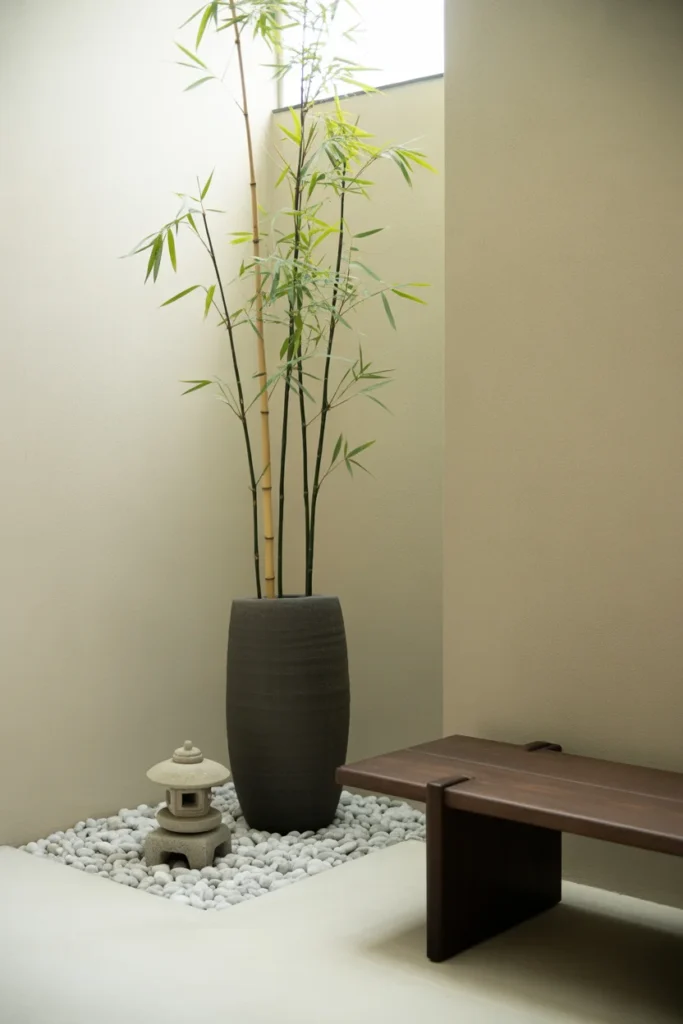
A mini bamboo and pebble corner with three bamboo culms, smooth white pebbles, a stone lantern, and a simple bench achieves the most characteristically Japanese of all design qualities at corner scale. It achieves maximum calm through minimum means. Three bamboo culms are enough to create the visual structure, the sound, and the organic vertical presence of the bamboo garden tradition. A handful of smooth white pebbles creates the clean mineral ground plane. A small lantern provides the traditional focal accent. Nothing more is needed and nothing more should be added.
Tip: Clean bamboo culms in the container monthly with a soft damp cloth to remove accumulated dust from the culm surface and reveal the natural green quality of the bamboo beneath. Bamboo culms in an indoor or sheltered outdoor position accumulate a visible layer of dust that dulls their characteristic bright green surface color and reduces their most beautiful visual quality. Monthly cleaning takes two minutes per culm and restores the bamboo to its most vivid and most genuinely Japanese green quality each time it is performed.
6. Windowsill Moss and Stone Garden
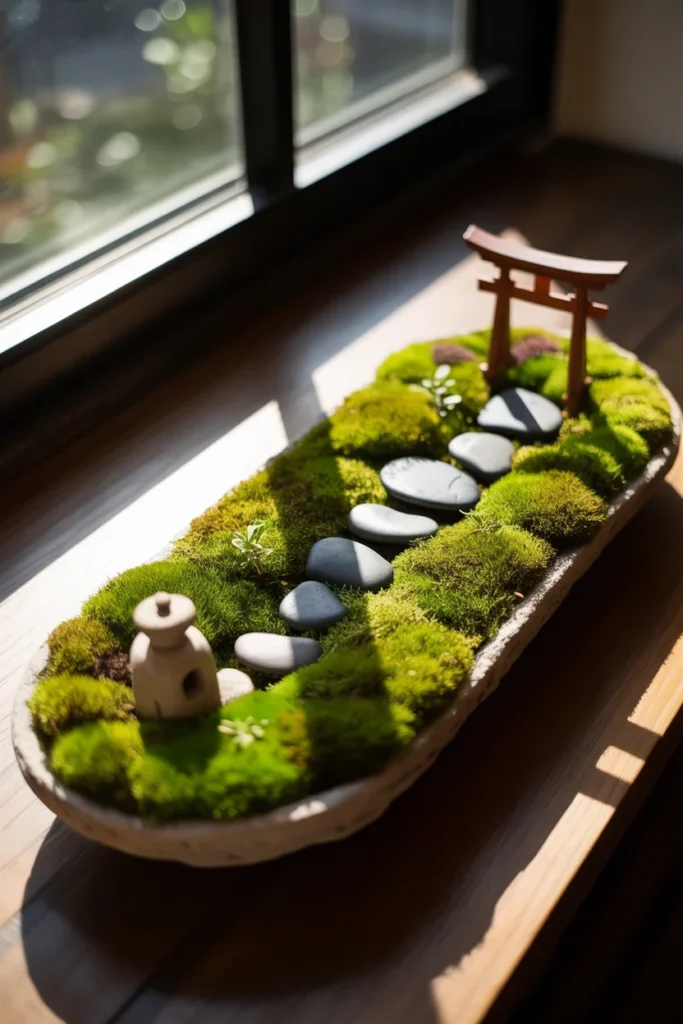
A windowsill moss and stone garden with a miniature torii gate and a tiny stone lantern is the Japanese garden format that lives most intimately with the person who tends it because it is positioned at the exact boundary between the interior world and the exterior world, available as a contemplative view from inside the room and simultaneously connected to the outdoor light that makes moss most beautifully luminous. It is the mini garden that is always visible without being deliberately sought.
Tip: Position the windowsill moss garden in bright indirect window light rather than direct sun for the most sustained and most beautiful living moss quality. Direct sun desiccates moss rapidly, turning it from lush living green to brittle brown within days of sun exposure. Bright indirect light provides the photosynthetic energy that moss requires for its most vibrant green growth without the moisture loss that direct sun creates. North or east facing windowsills in the northern hemisphere provide the most consistent bright indirect light appropriate to sustained living moss garden quality.
7. Small Courtyard Zen Garden
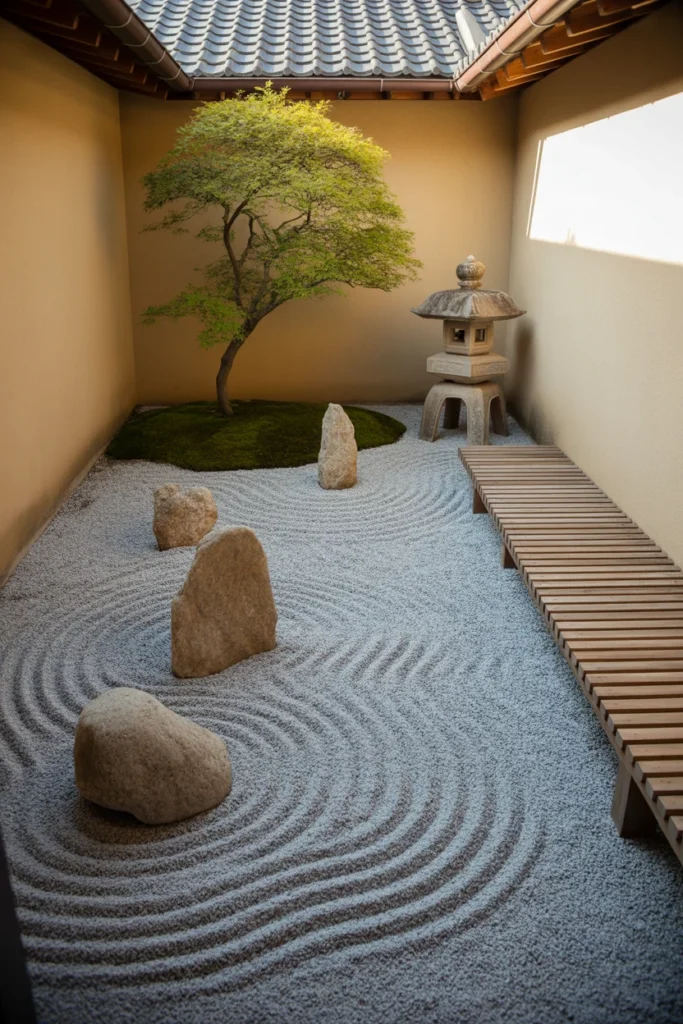
A small enclosed courtyard Zen garden with raked gravel, natural stones, a single pruned Japanese maple, and a weathered stone lantern is the mini Japanese garden format that achieves the most complete sense of genuine outdoor Japanese garden atmosphere because the enclosing courtyard walls create the spatial separation from the larger world that the Japanese garden tradition has always understood is essential to the meditative garden experience. The enclosure is not a limitation. It is the condition that makes the calm possible.
Tip: Keep all courtyard walls in a consistent neutral white or natural render finish and resist the temptation to add art, climbing plants, or decorative elements to the courtyard walls of the Zen garden space. The clean neutral wall is not an empty or unfinished surface in the Zen courtyard context. It is the visual silence that allows the raked gravel, the natural stones, the maple, and the stone lantern to be experienced as the complete and sufficient garden composition they are. Any addition to the wall competes with that composition and reduces the Zen quality of the complete courtyard garden experience.
8. Mini Japanese Rock Garden Box
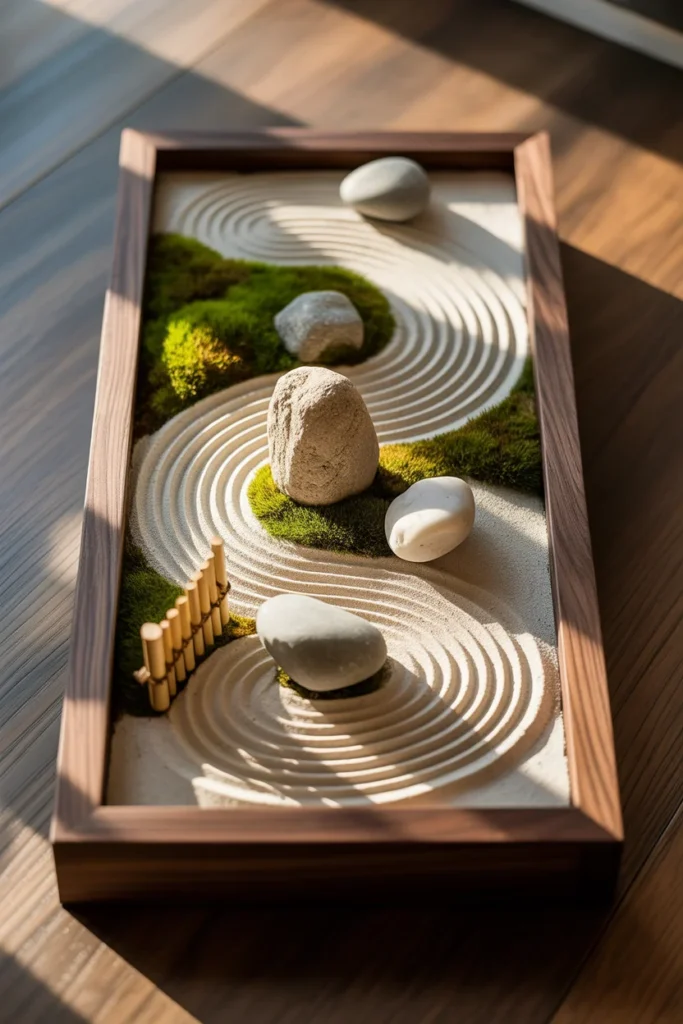
A mini Japanese rock garden in a handcrafted dark wood box frame is the most artisan crafted and most portably beautiful mini Japanese garden format because the quality of the box itself communicates the care and craft intention of the person who made or chose it, and that communication of genuine care is one of the most fundamentally Japanese of all design qualities. The box should be beautiful enough to be a finished object even before the sand and stones are arranged within it.
Tip: Make the dark wood box for the mini rock garden from untreated hardwood such as oak, cedar, or teak rather than treated or engineered wood products for the most beautiful and most genuinely natural box material. Untreated hardwood develops its own natural patina and aging character with time and use that treated or engineered wood products cannot replicate. The box will be handled daily for the raking practice and will develop its own particular warmth and character through that daily handling over months and years. That accumulated character of daily use is the most genuinely Japanese quality available to a handmade mini rock garden box.
9. Terracotta Pot Japanese Garden
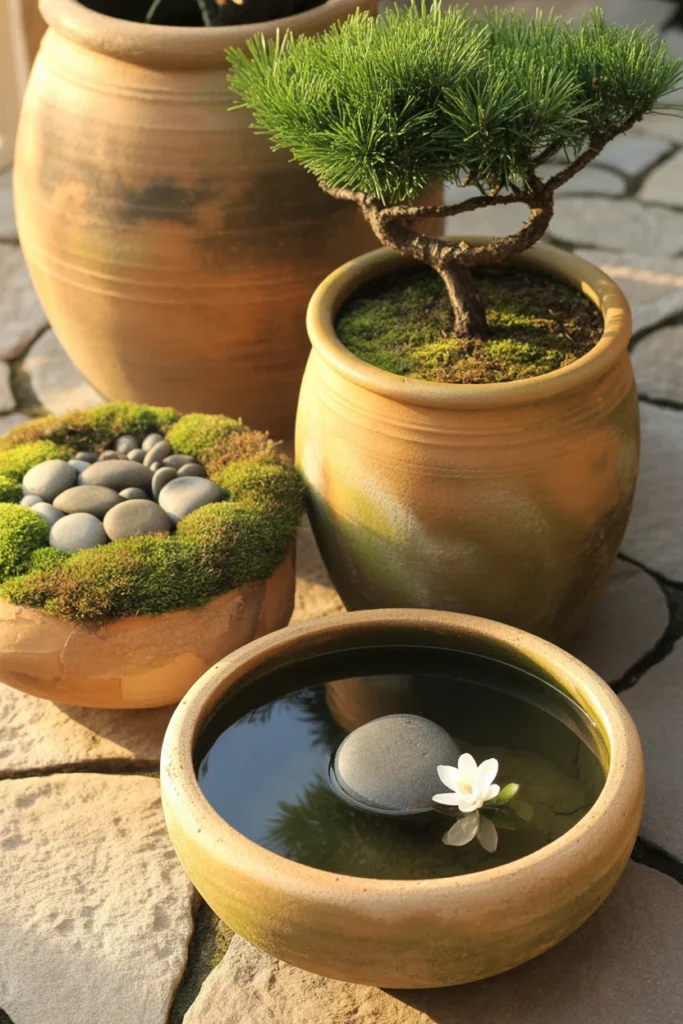
A terracotta pot Japanese garden arrangement is the mini Japanese garden format that most completely embodies the Japanese aesthetic principle of wabi, the beauty of imperfection, age, and organic natural character. Terracotta pots that have spent seasons outdoors developing their patina of mineral deposits, moss patches, and weather staining are more beautiful to the Japanese aesthetic sensibility than new terracotta pots precisely because that accumulated patina is the evidence of genuine outdoor time and genuine organic experience.
Tip: Arrange the terracotta pots at three distinctly different heights using natural stone or weathered wood pieces beneath the smaller pots as risers for a more dynamic and more genuinely Japanese three dimensional composition. A collection of terracotta pots all at the same ground surface height reads as a flat arrangement. A collection at three different heights creates a composition with genuine spatial depth and a visual rhythm that the eye moves through more interestingly. The height variation is the single most effective compositional adjustment available to the terracotta pot Japanese garden arrangement.
10. Indoor Mini Zen Sand Garden
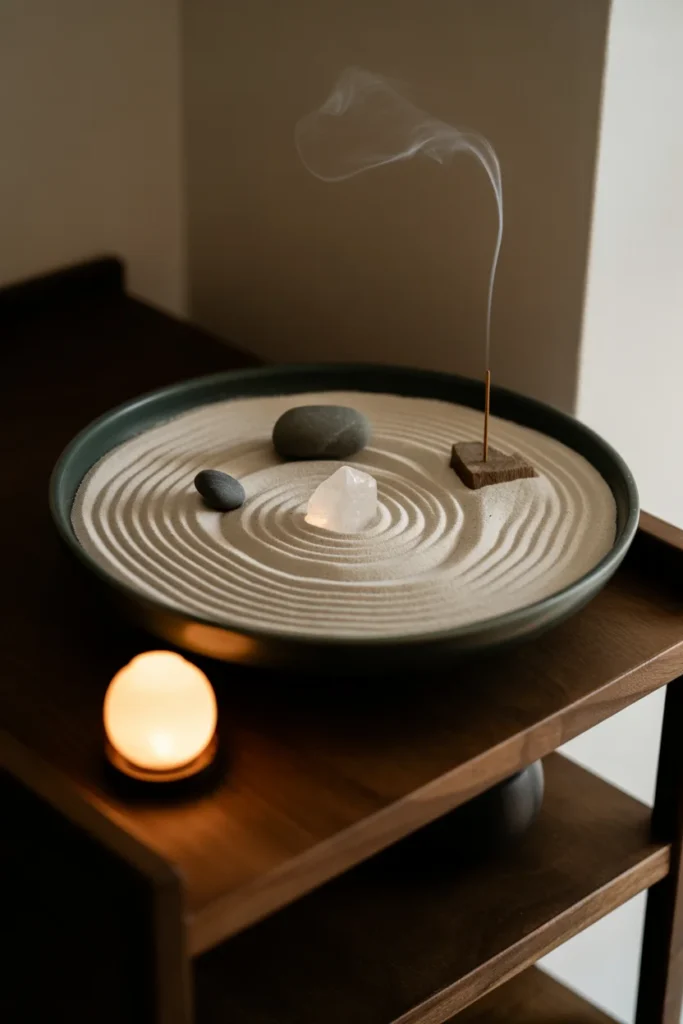
An indoor mini Zen sand garden in a wide shallow ceramic dish with incense and warm lamp side lighting is the most completely sensory mini Japanese garden format available for indoor spaces because it engages the visual sense through the raked sand pattern, the tactile sense through the raking practice, the olfactory sense through the Japanese incense fragrance, and the contemplative mind through the meditative practice of creating a precise and temporary order in the sand. Four senses engaged simultaneously through one small ceramic dish of white sand.
Tip: Use Japanese cedar, hinoki cypress, or sandalwood incense rather than heavily fragranced floral or complex blended incense in the indoor mini Zen sand garden for the most authentic and most genuinely calming olfactory Japanese garden atmosphere. Japanese incense in cedar or cypress has a clean, natural, woody fragrance that is closely associated with the material character of traditional Japanese architecture, garden structures, and the tea ceremony environment. Its fragrance is calm rather than stimulating, grounding rather than elevating, and genuinely appropriate to the meditative practice of the indoor Zen sand garden.
11. Small Deck Japanese Garden Setup
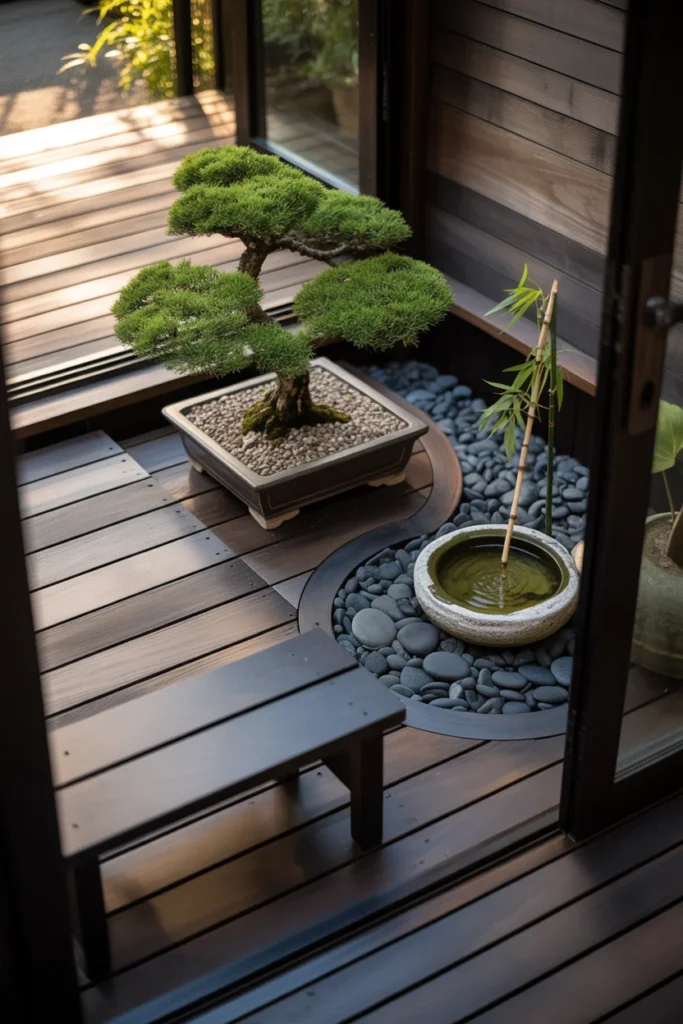
A small deck Japanese garden with a cloud pruned juniper, a dry stream stone arrangement, a bamboo water feature, and a simple low bench achieves the most functionally complete Japanese garden experience available at deck scale because it includes every essential Japanese garden element, a living botanical focal point, a mineral ground composition, a water and sound element, and a contemplative seating position, within a floor plan that most small decks already naturally provide.
Tip: Begin cloud pruning the deck juniper gradually over three or four growing seasons rather than attempting a dramatic transformation in the first season. Cloud pruning is a cumulative practice that removes individual branch sections over several years to progressively reveal and enhance the natural branching structure while creating the characteristic rounded foliage pad forms. Attempting to create the complete cloud pruning effect in one session risks removing too much foliage at once, shocking the plant, and producing a result that looks pruned rather than shaped. Patient gradual pruning over several seasons produces the most beautiful and the most genuinely Japanese cloud pruning result.
12. Mini Koi Container Pond
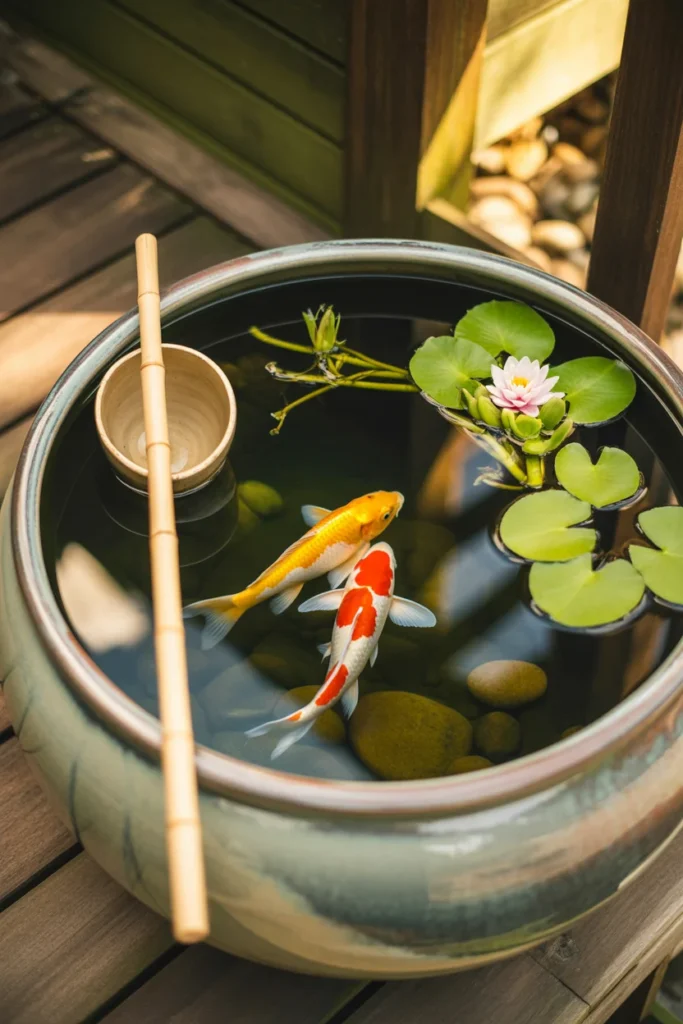
A mini koi container pond with two or three small goldfish or young koi, floating water plants, and a traditional bamboo ladle is the mini Japanese garden format that is most continuously alive and most genuinely interactive because the fish within it create a living daily presence that no static garden element can replicate. The morning observation of how the fish have moved through the night, the feeding ritual, the daily quality of the water, and the gradual growth of the fish over months and years all create a sustained relationship between the garden and its keeper.
Tip: Use water lettuce and water hyacinth as natural biological filtration plants in the mini koi container pond rather than relying on mechanical filtration alone for the most ecologically balanced and most beautifully natural container pond water quality. Water lettuce and water hyacinth absorb the excess nitrogen produced by fish waste directly through their root systems, converting it into plant growth rather than allowing it to accumulate as algae promoting nutrients in the water. The natural filtration provided by these floating plants, combined with their beautiful floating leaf form, creates both better water quality and a more genuinely Japanese container water garden aesthetic simultaneously.
13. Apartment Balcony Japanese Corner
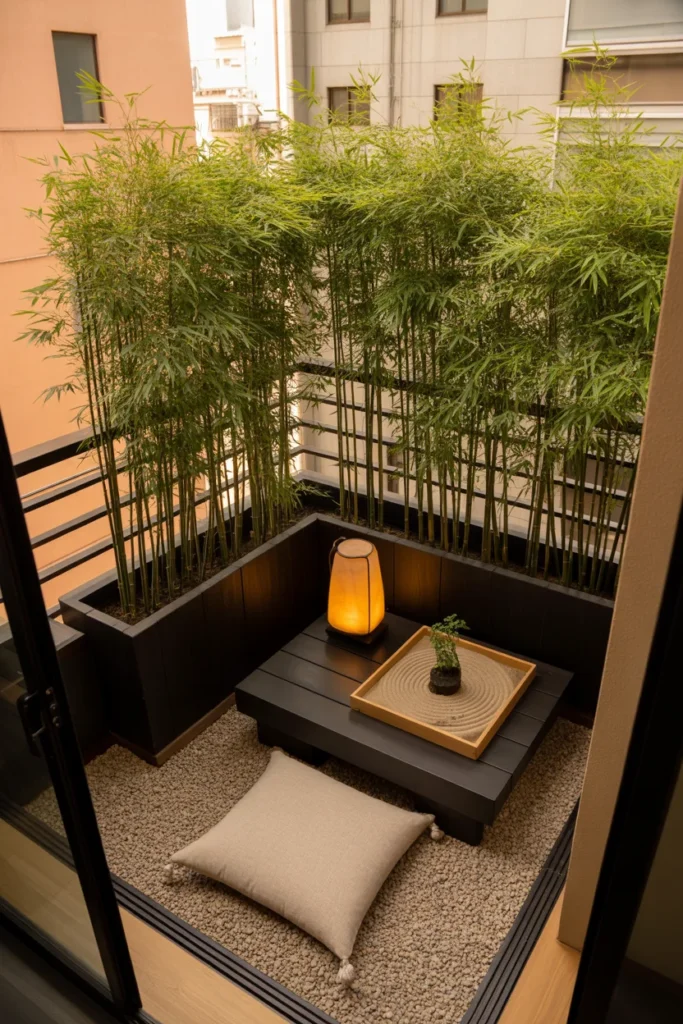
An apartment balcony Japanese corner with compact bamboo, a dark wood gravel platform, a mini Zen tray, a traditional lantern, and a low linen floor cushion creates the most complete Japanese garden retreat experience available in the smallest and most constrained urban outdoor space format. It proves that the Japanese garden tradition belongs to everyone regardless of their available outdoor space because its most essential quality has never been about the size of the garden. It has always been about the quality of the intention that created it.
Tip: Approach the apartment balcony Japanese corner as a complete and sufficient space rather than as a compromise version of a larger garden. The most common mistake in small space Japanese garden design is the addition of too many elements in an attempt to compensate for the limited scale, creating a crowded and visually busy space that lacks the quality of meaningful empty space that Japanese garden design most fundamentally requires. Three elements chosen with complete intention and placed with absolute care in an apartment balcony corner will always produce a more genuinely Japanese and more genuinely calming garden experience than ten elements crowded into the same space.
Conclusion
A mini Japanese garden of any format, whether a tabletop Zen tray or a small courtyard installation, delivers the same fundamental quality that the Japanese garden tradition has always been most valued for: the quality of bringing genuine calm to the person who creates it, tends it, and spends quiet time within or beside it.
The scale changes. The philosophy does not. The raked sand pattern in a wooden tray on the desk requires the same quality of focused present moment attention as the raked gravel in a Zen monastery garden. The bonsai in its ceramic pot on the table requires the same patient botanical observation as the ancient pine in a garden centuries old. The lotus in the ceramic bowl on the patio carries the same spiritual resonance as the lotus in the most sacred Japanese garden pond.
Begin with the mini Japanese garden format that fits most naturally into your available space and your daily life. The windowsill moss tray for the apartment with no outdoor space. The balcony Japanese corner for the urban apartment. The small courtyard Zen garden for the house with a small enclosed outdoor space. The tabletop bonsai for the desk that needs something genuinely alive and genuinely contemplative within its daily visual field.
Start small. Rake daily. Water the moss. Watch the fish. Listen to the bamboo water feature. Let the seasons change the Japanese maple and let the maple teach you what the Japanese garden tradition has always known about impermanence, about patience, and about the extraordinary beauty that becomes available to any person willing to give their outdoor space, no matter how small, the quality of genuine and unhurried attention it deserves.
The mini Japanese garden is ready whenever you are.
Read More:-
13 Small Bedroom Decor Ideas That Make Every Inch Feel Intentional
17 Small Kitchen Ideas That Maximize Every Inch with Style
14 Japanese Garden Ideas That Bring Instant Calm to Any Outdoor Space